
A new year always feels like a fresh start. For tradie and field service businesses, it’s more than that – it’s a chance to step back from the daily rush and ask, “Is the way we’re working actually sustainable?”
2025 was busy but chaotic. Jobs got done, but the office felt stretched, techs were frustrated with constant changes, and cash flow never quite felt stable. The work quality was there, but the workflows weren’t.
The good news: 2026 is a clean slate. With clearer processes, smarter data use, and the right job management software, you can turn that chaos into a more predictable, profitable operation. The key is to set smart goals for the field service business’s new year, choose the right field service KPIs to track, and build your systems around the key metrics for tradie businesses that actually drive results.
Let’s walk through seven practical ways to streamline field service operations and overall business this year.
1. Set Clear, Focused Goals for 2026
“Grow the business” or “be more organised” sounds nice, but it doesn’t give you or your team anything concrete to aim at. Vague goals create vague results.
This year, anchor your planning in specific, measurable goals. For example:
- Reduce the average job completion time by 20% by 30 June
- Send invoices within 24 hours for 90% of jobs by the end of Q2
- Lift the quote-to-win ratio from 30% to 45% by September
These goals for the field service business’s new year are easy to understand and easy to track. Your office staff know what “good” looks like. Your techs can see how their work contributes. And you can monitor progress through your software instead of guessing.
You can follow a simple process to set goals. Look at last year’s numbers, decide where the pain was: slow cash flow, missed bookings, low profit, or rework, and turn that pain into a specific, time-bound goal.
Three to five clear goals are more than enough. The point is focus, not a long wish list.
2. Choose the Right Field Service KPIs to Track
Goals tell you where you’re heading. KPIs show you whether you’re moving in that direction or going sideways.
There are endless numbers you could track, but you’ll get the best return by focusing on a small set of field service KPIs to track that actually influence decisions.
Some of the most valuable key metrics for tradie businesses include:
- First-time fix rate: Percentage of jobs completed in one visit.
- Average response time: Time from booking to arrival on site.
- Job completion time: Time spent actually doing the work.
- Technician utilisation: Proportion of the day spent on billable work.
- Quote-to-win ratio: How many quotes turn into approved jobs.
- Invoice lag: Days from job completion to invoice sent.
Each KPI highlights a different part of your workflow. A low first-time fix rate suggests poor preparation or missing parts. Long response times hint at weak scheduling. High invoice lag explains why the bank account feels light even when the team is flat out.
Once you choose your KPIs, put them on a dashboard in your job management software. Review them weekly or fortnightly – not just at tax time- and share key numbers with the team so everyone sees the impact.
The goal isn’t to collect data for the sake of it. It’s to have a simple, honest picture of how the business is performing.
3. Standardise Your Workflow from Quote to Invoice
Most field service businesses don’t fail because the work on-site is poor. They struggle because of the gaps between stages: slow quoting, clumsy scheduling, missing job notes, and delayed invoicing.
To streamline, you need a standard, repeatable workflow that every job follows. Think of it as a simple “track” each job runs along.
A basic end-to-end workflow might look like this:
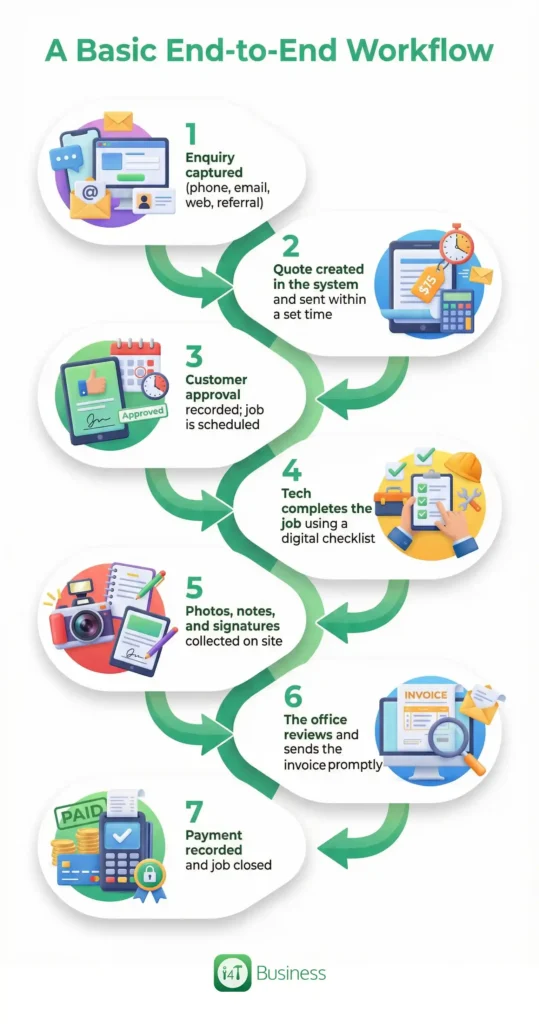
- Enquiry captured (phone, email, web, referral).
- Quote created in the system and sent within a set time.
- Customer approval recorded; job is scheduled.
- Tech completes the job using a digital checklist.
- Photos, notes, and signatures collected on site.
- The office reviews and sends the invoice promptly.
- Payment recorded and job closed.
If you map your current process honestly, you’ll quickly see where things fall apart. Maybe quotes sit in drafts too long. Maybe job cards don’t make it back to the office. Maybe invoices wait for missing details from the field.
Field service management software like i4T Business helps lock in this workflow by providing templates for different job types, making key fields mandatory, and moving jobs through clear statuses (quoted, booked, in progress, completed, invoiced).
Standardisation doesn’t mean you lose flexibility. It means you stop reinventing the wheel for every job and start building habits that support speed, accuracy, and profit.
4. Level Up Scheduling and Dispatch
Scheduling often feels like a daily firefight: cancellations, urgent jobs, traffic, sick days. But with better structure, it can become a strength rather than a constant headache.
Efficient scheduling aims to:
- Put the right tech on the right job based on skills and licences.
- Minimise travel by grouping jobs by area where possible.
- Use realistic time slots based on your own historical data.
- Make it easy to reshuffle when things change.
When your schedule lives inside a system like i4T Business, you can see who is available and when, where each tech is scheduled to be, and which jobs are urgent vs flexible.
Drag-and-drop calendars and map views make it much easier to balance workloads and reduce wasted time. If a tech finishes early, you can quickly slot in a nearby job. If someone runs late, you can adjust the rest of the day without losing control.
Real-time dispatch is the other half of the story. Techs should be able to:
- See their job list, customer details, and notes on a mobile app.
- Update status as they go: en route, on site, completed.
- Access job history so they know what’s been done before.
Those updates feed straight back into your field service KPIs to track, such as response time and utilisation, giving you a live picture of how the day is unfolding.
5. Digitise Field Data
Paper job cards and handwritten notes might feel comfortable, but they’re slow, fragile, and hard to analyse. They get lost, damaged, or delayed, and they make your reporting unreliable.
Digitising field data changes that. When techs handle everything through an app, they can:
- View job scope and safety requirements clearly.
- Complete digital checklists tailored to each job type.
- Attach photos and videos as proof of work.
- Record parts and materials used on the spot.
- Capture customer sign-off in seconds.
As soon as they complete the job, the information is available in the office. No waiting for paperwork. No decoding messy handwriting. No missing details when it’s time to invoice.
This richer, cleaner data feeds directly into your key metrics for tradie businesses. You gain insight into actual job duration vs estimated duration, common reasons for callbacks or rework, and profitability by job type or customer.
Yes, there’s a short learning curve for techs who aren’t used to working digitally. But once they see that it reduces paperwork, cuts phone calls from the office, and makes their day more predictable, most are happy to switch.
6. Use Real-Time Reporting to Make Better Decisions
Many owners rely on instinct: you “feel” busier or “sense” that a certain type of job isn’t paying off. Sometimes that intuition is right. But if you want to scale or improve margins, you need data to back it up.
Real-time reporting turns the information you already collect into practical insight. With i4T Business, for example, you can see:
- Jobs completed this week vs previous weeks.
- Average job duration by service type.
- Revenue and margin by technician or team.
- Overdue invoices and total outstanding amounts.
Instead of waiting for end-of-year accounts, you get ongoing feedback. That allows you to:
- Adjust pricing for unprofitable services.
- Offer training where certain jobs always run over time.
- Identify high-performing techs and learn from what they do well.
- Tighten up invoicing and follow-up before cash flow becomes a problem.
Your field service KPIs to track become part of your regular rhythm; something you glance at weekly and discuss with your team, not just numbers buried in a spreadsheet.
Small course corrections throughout the year are far easier than big, painful changes once things have gone off track.
7. Automate Customer Communication and Follow-Up
In 2026, good work alone isn’t enough. Customers expect clear communication: confirmation of bookings, updates on arrival times, and quick access to quotes and invoices. If you try to do all of that manually, you’ll inevitably miss something.
Automation doesn’t mean cold or robotic. It means using your system to handle the routine messages so your team can focus on the actual work.
Useful automations include:
- Booking confirmations when a job is created.
- Reminders the day before or the morning of the job.
- “On the way” notifications with an ETA when the tech starts driving.
- Post-job messages asking for feedback or a review.
- Invoice reminders after a set number of days.
These touchpoints improve the customer experience, reduce no-shows, and support your key metrics for tradie businesses. You get to understand customer satisfaction and review scores, repeat job and referral rates and how long it takes to get paid.
Automated communication makes your business look organised and reliable, without placing extra pressure on your office staff.
Bringing It All Together with i4T Business
You can try to manage all this with whiteboards, group chats, and memory – but it’s stressful and fragile. One busy week and the whole system creaks.
A platform like i4T Business pulls everything into one place so you can:
- Set and track clear goals for the field service business new year.
- Monitor the most important field service KPIs to track in real time.
- Standardise your workflow from quote to invoice.
- Schedule and dispatch work with live visibility.
- Capture field data digitally and accurately.
- Automate communication and invoice follow-ups.
- Report on the key metrics for tradie businesses that matter most.
The result: less guesswork, fewer surprises, and a business that feels far more under control.
Ready to make 2026 your smoothest year yet?
If you’re serious about tightening your workflows and running a more efficient operation, now’s the time to act.
Book a demo or start a free trial of i4T Business, and let’s walk through your current setup. Together, we can streamline your processes, lock in the right KPIs, and turn 2026 into a year where your business works as hard, and as smart, as you do.
FAQs
Start with a small set: first-time fix rate, average response time, job completion time, quote-to-win ratio, and invoice lag. These give a strong overview of efficiency and cash flow.
Three to five clear, measurable goals are ideal. Any more and it becomes hard to focus; any fewer and you may miss important areas.
Yes. Even small teams benefit from having all jobs, customers, and invoices in one system, plus simple reporting on performance.
After a short adjustment period, most techs find digital job cards faster and easier than paper, especially for photos, notes, and signatures.
i4T Business captures data from every job, then turns it into dashboards and reports. That makes it easier to understand your performance and take action to improve it.
Hot off the press!