


//
Share this article

Table of Contents

2030: The Evolution of Field Services - Transforming Australia's Industry

2030: The Evolution of Field Services – Transforming Australia’s Industry

Table of Contents

Key Takeaways

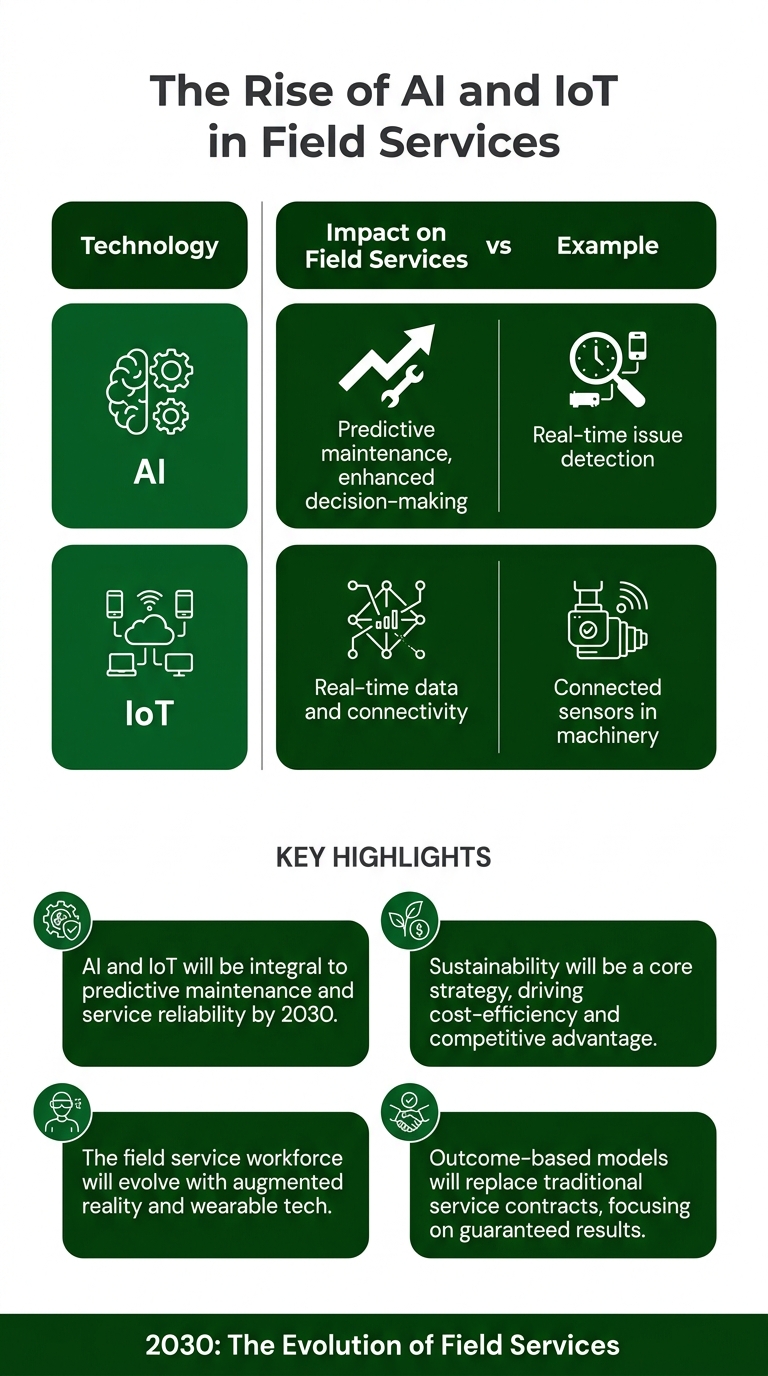
  • AI and IoT will be integral to predictive maintenance and service reliability by 2030.

  • Sustainability will be a core strategy, driving cost-efficiency and competitive advantage.

  • The field service workforce will evolve with augmented reality and wearable tech.

  • Outcome-based models will replace traditional service contracts, focusing on guaranteed results.

Key Answer

By 2030, Australian field services will embrace AI, IoT, and sustainability, transforming operational efficiency and service delivery.

As we approach a new decade, the field services landscape in Australia is on the brink of transformative change. By 2030, the evolution of field services will transcend the mere integration of cutting-edge technology, focusing instead on redefining efficiency and sustainability. This transformation is propelled by advancements in AI, IoT, and a growing emphasis on sustainable operations.

The Rise of AI and IoT in Field Services

AI and IoT are at the forefront of the technological revolution reshaping field services. The integration of these technologies is transforming business operations, enhancing efficiency and reliability. AI-driven predictive maintenance empowers companies to anticipate issues before they arise, thereby minimising downtime and boosting service reliability.

In the realm of IoT, sensors and connected devices are becoming ubiquitous, providing real-time data that helps in making informed decisions. This seamless flow of information enables technicians to be proactive rather than reactive, offering service models that guarantee uptime and enhance customer satisfaction. With Australia’s robust telecommunications infrastructure, the adoption of IoT in field services is set to skyrocket by 2030.

Technology

Impact on Field Services

Example

AI

Predictive maintenance, enhanced decision-making

Real-time issue detection

IoT

Real-time data and connectivity

Connected sensors in machinery

Sustainability: A Core Pillar by 2030

As industries worldwide shift towards greener practices, sustainability has become a crucial factor in field services. By 2030, sustainable operations will not only be a regulatory requirement but also a competitive advantage for Australian businesses. Organisations are adopting technologies such as electric vehicles for logistics, optimised routing to minimise carbon footprints, and recommending energy-efficient solutions to clients.

Moreover, sustainable practices are intertwined with cost-efficiency, as optimising resources leads to reduced operational costs. Thus, by adopting sustainability strategies, businesses can ensure compliance, cut costs, and enhance their brand reputation.

Expert Perspective

Field Service Analyst

In my view as a field service analyst, the transition to 2030’s advanced service models represents a significant shift towards sustainability and technology. This not only enhances efficiency but also aligns with global environmental goals, paving the way for a more resilient industry.

Future Workforce: The Augmented Technician

The field service workforce of 2030 will be markedly different, defined by augmented technicians utilising wearable tech and augmented reality (AR) tools. This evolution addresses the skilled labour shortage and enhances service precision. Wearable devices will offer technicians hands-free access to real-time data, instructions, and remote expert support, enabling them to tackle complex tasks more efficiently.

As highlighted in the empowerment of mobile apps, AR will facilitate training and skill development, making it easier for new technicians to assimilate into the workforce. This change will also lead to better job satisfaction and higher retention rates, as technicians find their roles more engaging and less monotonous.
infographic_1cYxazB62Z.jpg

The Shift Towards Outcome-Based Models

By 2030, field services will shift from traditional break-fix models to outcome-based service contracts. These contracts will prioritise guaranteeing equipment uptime and offering ‘Product-as-a-Service’ (PaaS) solutions, where customers pay for outcomes rather than ownership.

This shift is beneficial for both customers and service providers. Customers gain from increased reliability and reduced unplanned downtime, while providers achieve stable revenue through recurring service agreements. This model also encourages continuous improvement and innovation from service providers.

Local Manufacturing and On-Demand Solutions

With the increasing complexity of global supply chains, localised manufacturing through 3D printing will become an essential solution for field service providers. By 2030, the ability to print parts on-demand will significantly reduce lead times and eliminate reliance on international shipments. This capability not only enhances efficiency but also aligns with sustainability goals by reducing transportation emissions.

Furthermore, as highlighted in industry trends, the integration of micro-fulfillment centres will allow field service providers to stock essential parts and tools closer to customer locations, ensuring faster service delivery and increased customer satisfaction.

Frequently Asked Questions

AI will be essential for predictive maintenance, enhancing decision-making, and reducing downtime.

Sustainability will drive cost-efficiency and compliance, becoming a competitive advantage for businesses.

The workforce will incorporate augmented reality and wearable tech, improving skill development and operational efficiency.

These models focus on guaranteeing service outcomes such as uptime, rather than just repairs or maintenance.

Local manufacturing, like 3D printing, will reduce lead times and dependency on international supply chains, improving service efficiency.

Sources & Further Reading

Scroll to Top