

//
Share this article

Table of Contents

AI in Field Service: Practical Use Cases, Risks, and How to Start

AI in Field Service: Practical Use Cases, Risks, and How to Start

Table of Contents

Key Takeaways

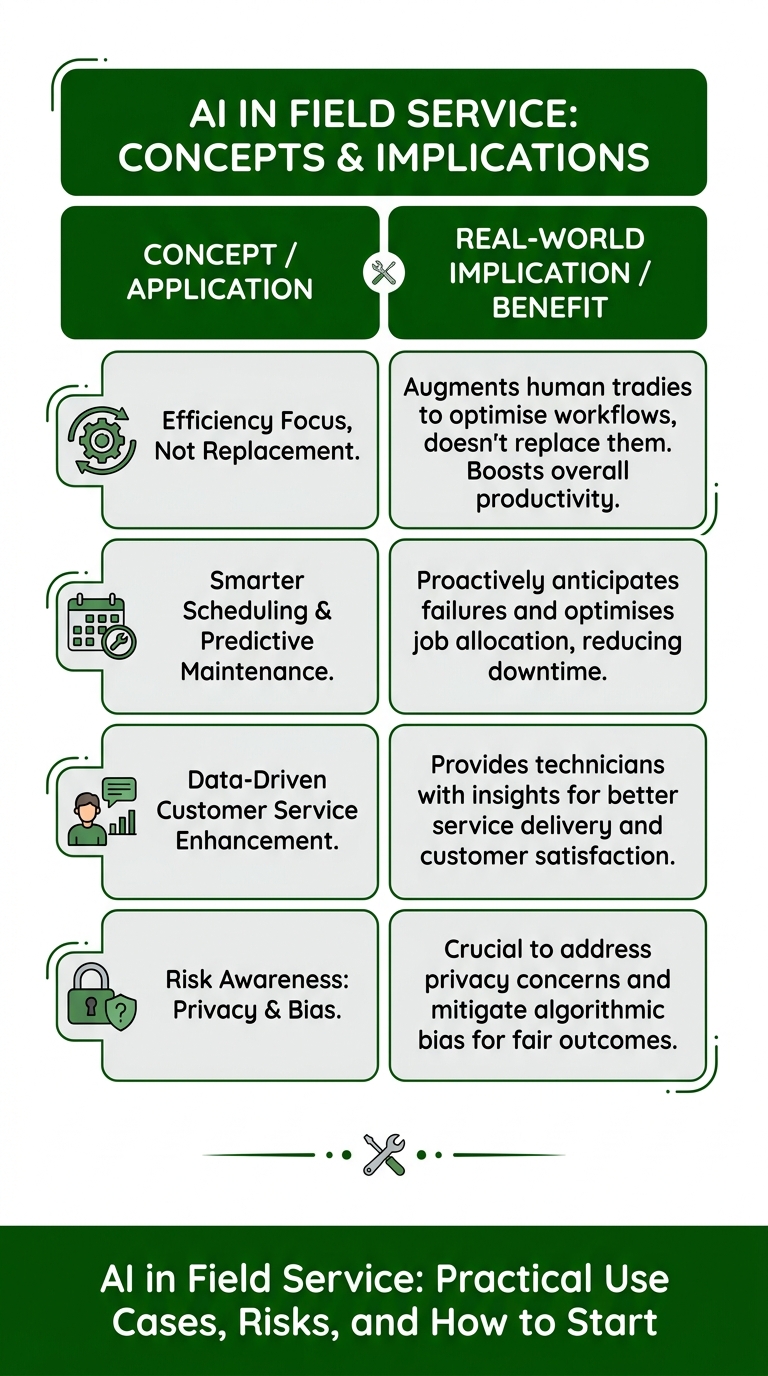
  • AI in field service focuses on improving efficiency, not replacing tradies.

  • Predictive maintenance and smarter scheduling are key AI applications.

  • AI can enhance customer service by providing data-driven insights.

  • Privacy concerns and algorithmic bias are notable risks of AI.

Key Answer

AI in field service streamlines operations for tradies by enhancing scheduling, reducing admin tasks, and improving customer interactions. Understand the practical use cases, risks, and strategies to start safely in the Australian market.

Artificial intelligence (AI) is reshaping the way tradies operate in the field service sector. With a focus on practical applications rather than hype, AI in field service promises to streamline operations, boost efficiency, and improve customer satisfaction.

In this guide, we’ll explore “AI in Field Service: Practical Use Cases, Risks, and How to Start”, tailored specifically for Aussie tradies.

As the demand for field service efficiency grows, AI field service software is emerging as a key player. By harnessing AI-powered field service management, tradies can cut through the noise and focus on real-world benefits like improved scheduling and smarter decision-making.

Let’s dive into what AI in field service management actually means, where it’s already making waves, and how you can get started without a hitch.

What Does AI in Field Service Management Actually Mean?

AI in field service management refers to integrating artificial intelligence into the daily operations of trade businesses. This isn’t just about having robots take over; it’s about using smart algorithms to make better decisions, automate routine tasks, and ultimately make life easier for tradies.

For example, AI field service software can analyse data from past jobs to predict future needs, optimise scheduling by considering factors like traffic and technician availability, and even automate customer communications.

Think of AI as a tool that enhances, rather than replaces, human expertise.
infographic_wxwT3M31cf.jpg

Where Is AI Being Used in Field Service Today?

AI is already being utilised in various aspects of the field service industry. One key area is predictive maintenance, where AI helps anticipate equipment failures before they occur. This not only saves time but also reduces costs by preventing unexpected breakdowns.

Scheduling and dispatch are also benefiting from AI. Instead of manually juggling appointments, AI algorithms can automatically assign the right technician to the right job based on proximity, expertise, and current workload. This ensures a more efficient use of resources and a faster response to customer needs.

Another noteworthy application is in data management. AI can sift through mountains of data to extract valuable insights, helping business owners make informed decisions about where to allocate resources or identify trends in customer service requests.

For more insights, you can check out our article on how AI is reshaping the trades industry.

How Can AI Improve Scheduling, Dispatch and Admin?

AI streamlines scheduling and dispatch processes by analysing various data points to make intelligent decisions. With AI field service software, you can reduce human error, optimise technician routes, and ensure that the right person is always assigned to the right job. This leads to higher job satisfaction and better customer service.

In the realm of admin tasks, AI can automate everything from generating invoices to organising job reports. This means you spend less time drowning in paperwork and more time doing what you do best–delivering top-notch service to your clients.

Learn more about prioritising work orders with AI.

Can AI Improve Customer Service and Business Decisions?

Absolutely. AI-powered field service management systems help enhance customer service by offering faster response times and personalised service recommendations. For instance, AI can analyse customer data to predict which services might be needed next, allowing you to offer timely solutions before issues arise.

For business decisions, AI provides data-driven insights that can significantly impact your bottom line. By examining patterns in customer behaviour or service trends, AI helps you make strategic decisions about staffing, resource allocation, and marketing initiatives. This results in a more agile and responsive business model.

What Are the Risks of Using AI in Field Service?

Despite its benefits, there are risks associated with using AI in field service management. Data privacy is a major concern, as sensitive customer information must be protected. Additionally, relying too heavily on AI without human oversight can lead to errors, especially in situations requiring nuanced judgment.

Algorithmic bias is another risk, where AI may make decisions based on flawed data, leading to unfair treatment or errors in job assignments. It’s crucial to ensure that any AI system implemented is regularly monitored and fine-tuned to mitigate these risks.

Which Tasks Should You Not Hand Over Completely to AI?

While AI can automate many tasks, some should remain in human hands. Tasks that require empathy, such as handling customer complaints or negotiating contracts, should not be fully automated. These interactions benefit from human intuition and understanding.

Moreover, safety-related decisions, where a human touch can assess nuances better than any algorithm, should also remain human-led. It’s essential to remember that AI is a tool, not a replacement for human judgment.

How to Start Using AI in Your Trade Business

Begin your AI journey by identifying the specific problems you need to solve. Whether it’s streamlining scheduling or improving customer interactions, knowing your pain points will guide you to the right AI solutions.

Next, invest in a reliable AI field service software that integrates well with your current systems. Start small, perhaps with a pilot program, and gather feedback from your team to refine your approach.

Finally, ensure continuous learning and adjustment. AI systems learn from the data they process, so keep an eye on performance metrics and make necessary adjustments to optimise outcomes.

Start With the Problem, Not the AI

Remember, AI should serve as a means to an end, not the end itself. Focus on identifying the problems in your field service operations first. Whether it’s cutting down admin time, improving response rates, or enhancing customer satisfaction, align AI initiatives to these goals.

By keeping the focus on the real-world value AI can bring, you’ll ensure that your investments are both effective and worthwhile.

Ready to see what AI can do for your trade business? Start your free trial of i4T Business by clicking here.

Frequently Asked Questions

AI in field service management involves using artificial intelligence to automate and optimise operations like scheduling, dispatch, and customer service.

AI enhances field service operations through predictive maintenance, automated scheduling, and providing data-driven insights for better decision-making.

The risks include data privacy concerns, algorithmic bias, and over-reliance on AI without human oversight.

Start by identifying key problems to solve, invest in suitable AI software, begin with small pilot projects, and continuously refine your approach.

Tasks requiring human empathy and nuanced judgment, like customer complaints and safety decisions, benefit from human involvement.

Scroll to Top