

Key Takeaways
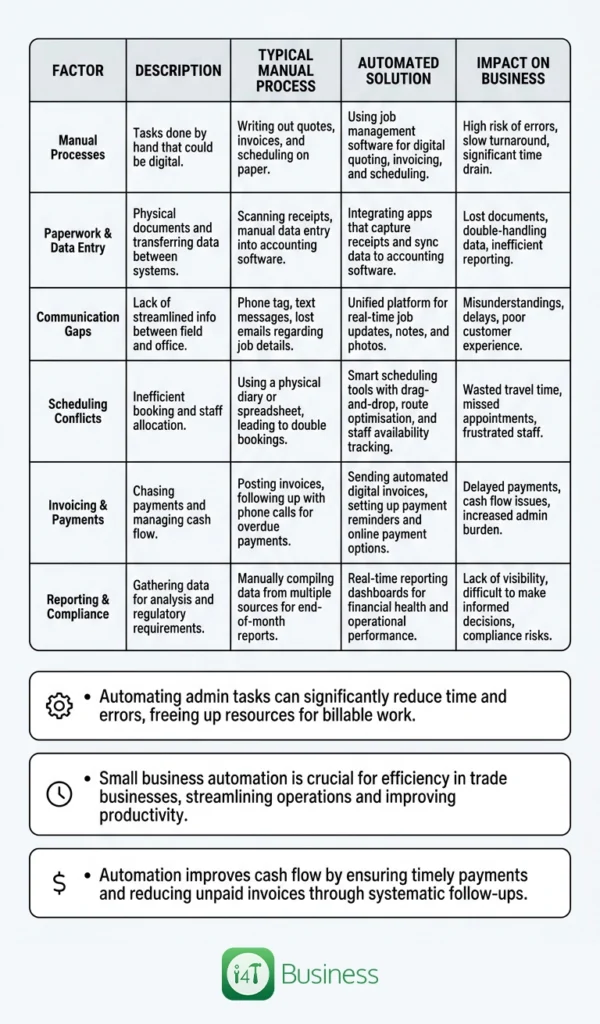
Automating admin tasks can significantly reduce time and errors.
Small business automation is crucial for efficiency in trade businesses.
Automation improves cash flow by ensuring timely payments and reducing unpaid invoices.
Key Answer
Discover how small business automation can help reduce admin time in your trade business without the need to hire more staff, focusing on efficiency and streamlined processes.
Running a trade business in Australia can be rewarding but also comes with its challenges, one of the most significant being admin overload. If you’re drowning in paperwork and emails while trying to manage quotes, invoices, and job schedules, you’re not alone. Many tradies and field service business owners find themselves in this predicament, desperately needing to cut down on admin without hiring extra staff. The answer lies in small business automation, a strategy designed to streamline operations and enhance efficiency.
Why Admin Time Builds Up in Trade Businesses
Admin time in trade businesses can quickly pile up due to a variety of reasons. First off, the sheer volume of tasks, from answering enquiries to invoicing, can be overwhelming. Many tradies often find themselves juggling multiple roles, particularly in smaller businesses where there isn’t a dedicated admin team.
Additionally, the lack of streamlined processes can lead to double handling of tasks. This means the same information is manually entered multiple times across different systems, which is not only time-consuming but also prone to errors. When you consider that each misstep could mean a follow-up call or another email, it’s easy to see how admin can take over your day.
What Is Small Business Automation for Tradies?
Small business automation for tradies involves using technology to automate repetitive and time-consuming tasks. This can include everything from automated email responses to complex job scheduling systems. By integrating these technologies into your daily operations, you can reduce the manual workload significantly.
Automation doesn’t just save time; it also reduces human error and increases efficiency, allowing you to focus more on the actual trade work rather than the admin that supports it. It’s about creating smarter workflows that help tradies keep up with the fast pace of the industry without expanding the team.
Start by Finding Your Biggest Admin Time Wasters
Before you can automate, you need to identify where your time is going. This involves conducting a waste audit of your current admin processes. Start by listing out all the tasks you handle daily, weekly, and monthly. Look for patterns where tasks are repeated or unnecessarily complicated.
Often, you’ll find that tasks such as following up on quotes or scheduling jobs are the biggest culprits. By identifying these areas, you can start to see where automation can have the most significant impact. You’ll not only streamline your operations but also free up more of your time for on-site work.
Automate Enquiries and Lead Follow-Ups
One of the simplest places to start with automation is enquiries and lead follow-ups. Implementing a customer relationship management (CRM) system can help automate responses to incoming enquiries and track potential leads. With automated emails, potential clients get immediate responses, enhancing your customer service without any extra effort on your part.
A CRM can also remind you of follow-up opportunities, ensuring that you never miss a lead. This proactive approach helps maintain customer interest and can significantly increase your conversion rates.
Automate Quoting and Approvals
Quoting is another area where automation can save a significant amount of time. Tools that generate quotes based on preset templates and parameters can eliminate the need for manual calculations and entries. This not only speeds up the process but also ensures that your quotes are accurate and consistent.
Automated approval systems can help further by allowing clients to approve quotes online, reducing the back-and-forth communication usually required. This streamlines the entire process, ensuring quicker acceptance and project commencement.
Automate Job Scheduling and Field Updates
Job scheduling and field updates are critical for maintaining smooth operations in a trade business. Automation tools can allocate resources, schedule staff, and update job statuses in real-time, ensuring that everyone is on the same page. With these tools, you can avoid the chaos of manual scheduling and last-minute changes that often disrupt workflow.
Using GPS and mobile devices, field updates can be relayed instantaneously, ensuring that any changes or updates are communicated efficiently to all team members. This not only saves time but also reduces the risk of missed appointments and miscommunications.
Automate Invoicing and Payment Follow-Ups
Invoicing and payment follow-ups are often some of the most tedious admin tasks. Automation can handle invoice generation and send reminders for overdue payments automatically. By integrating these tools with your accounting software, you can ensure that all financial transactions are accurately recorded without the need for manual entry.
This approach not only reduces admin time but also improves cash flow by ensuring that payments are received promptly. You’ll spend less time chasing unpaid invoices and more time focusing on growing your business.
Final Thoughts: Reduce Admin Before You Hire More Staff
Before considering additional hires, it’s crucial to explore how much admin you can automate. Not only does this save on labour costs, but it also optimises your existing processes. By leveraging small business automation, you can handle more work with the same team, reducing pressure and increasing job satisfaction.
Book a Demo of i4T Business today to see how you can transform your admin processes. Embrace automation to focus on what you do best, your trade.
Frequently Asked Questions
Tasks such as enquiries, quoting, job scheduling, invoicing, and payment follow-ups can be automated in a trade business to save time and reduce errors.
Automation can provide instant responses to customer enquiries and maintain consistent communication, enhancing overall customer satisfaction.
Yes, automation is highly beneficial for small trade businesses as it allows them to efficiently manage tasks without increasing staff numbers.
Automating admin tasks reduces the need for additional staff, decreases error-related costs, and improves cash flow by ensuring timely invoicing.
Automation helps streamline job scheduling by efficiently allocating resources, reducing manual errors, and ensuring real-time updates.