


//
Share this article

Table of Contents

Traditional FSM vs AI-Powered FSM: What's the Difference?

Traditional FSM vs AI-Powered FSM: What’s the Difference?

Table of Contents

Key Takeaways

  • Traditional FSM relies on manual processes and human input, making it prone to errors and inefficiencies.

  • AI-Powered FSM automates tasks, provides predictive insights, and enhances scalability, offering more streamlined operations.

  • AI can significantly improve scheduling, dispatch, and customer service, leading to better efficiency and satisfaction.

  • Deciding between traditional and AI-powered FSM depends on the specific needs and growth goals of your trade business.

Key Answer

Traditional FSM relies on manual scheduling and job tracking, while AI-Powered FSM leverages technology to automate and optimise these processes, enhancing efficiency and reducing errors.

In the world of Australian trades, the way you manage jobs can make or break your day. That’s where field service management (FSM) comes into play. But with technology evolving, the debate between Traditional FSM and AI-Powered FSM, often referred to as “intelligent FSM”, is heating up.

So, what’s the difference? More importantly, how does this impact field service automation and your daily grind? Let’s dive in and see what each offers.

What Is Traditional Field Service Management Software?

Traditional Field Service Management software is designed to help you manage the logistical aspects of your trade business. This includes scheduling jobs, dispatching technicians, and keeping track of work orders manually. Typically, these systems require a fair bit of manual input, often relying on spreadsheets, phone calls, and email threads to keep everything in line.

This traditional approach can be time-consuming and error-prone, especially as your business grows. The task of coordinating who goes where and when can quickly become a logistical nightmare without the right tools in place. Often, this leads to double-booking, missed appointments, or wasted travel time.

However, for many Australian tradies, traditional FSM systems are familiar and straightforward, offering a solid foundation to manage their operations. But as you’ll see, AI introduces a whole new way to tackle these challenges.

What Is AI-Powered Field Service Management?

AI-Powered Field Service Management, or “intelligent FSM”, takes traditional systems to the next level by incorporating artificial intelligence to automate routine tasks. This means your system can predict job durations, optimise routes, and even assist in scheduling by analysing patterns in your service data.

Unlike traditional FSM, AI-powered systems can process large volumes of data in real-time, allowing them to adapt to changes on the fly. For example, if a job takes longer than expected, the system can automatically adjust the schedule for the rest of the day, ensuring that no time is wasted.

The real beauty of AI in FSM is its ability to learn and improve over time. As it gathers more data, it becomes better at forecasting and decision-making, reducing the burden on your office staff and tradies alike.
infographic_4ndHkCAaql.jpg

Traditional FSM vs AI-Powered FSM: What's Different?

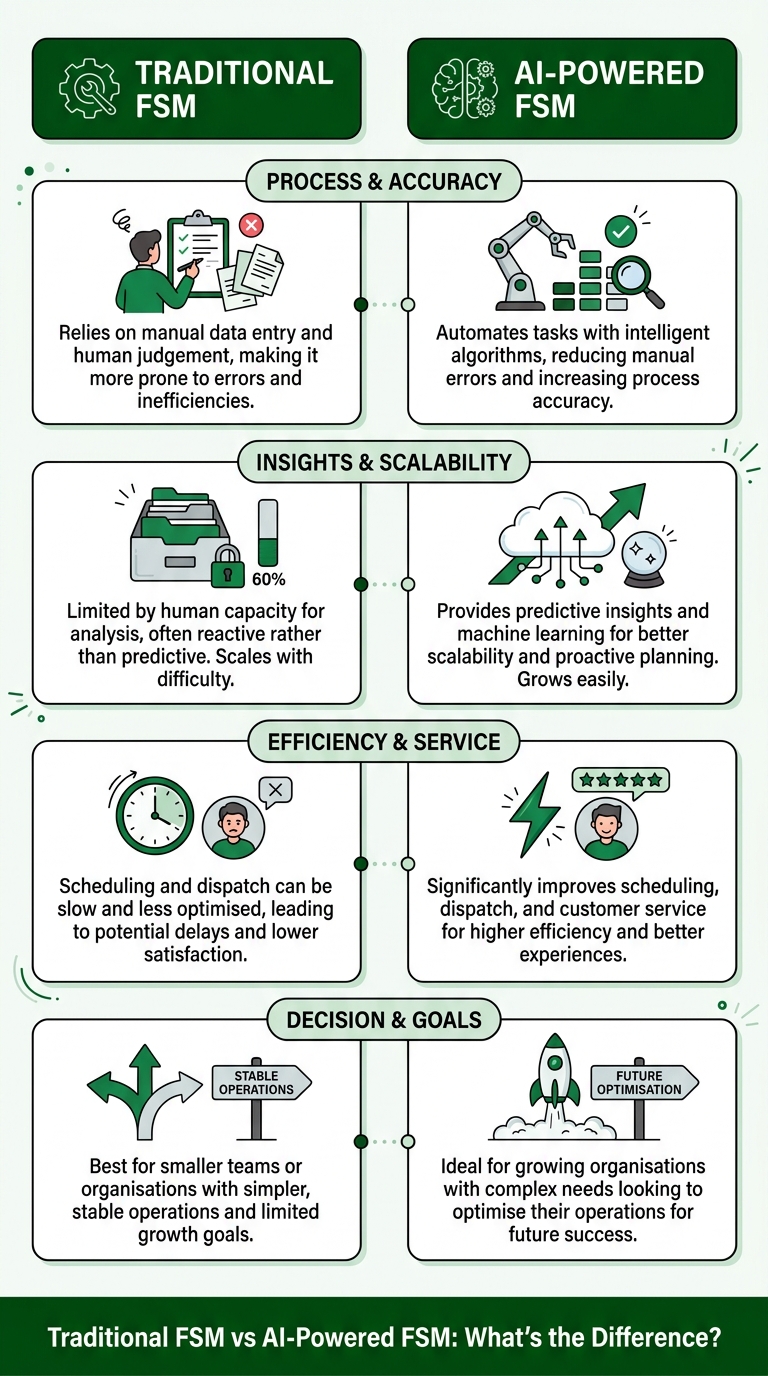
When comparing Traditional FSM with AI-Powered FSM, the differences boil down to automation and intelligence. Traditional FSM relies heavily on human input, whereas AI-powered systems automate these processes, offering dynamic scheduling and route optimisation based on real-time data.

AI can also offer predictive insights–like flagging when a piece of equipment is likely to fail before it actually does–thanks to its ability to analyse historical and current data. This feature can save you both time and money, reducing unexpected downtime.

Moreover, AI systems are more scalable. Whether your business is handling ten jobs a day or a hundred, AI can adapt to the workload seamlessly, whereas traditional systems might struggle under increased pressure.

Check out how AI is reshaping the trades industry to understand its evolving role.

How AI Can Improve Scheduling and Dispatch

One of the standout advantages of AI in FSM is its ability to transform scheduling and dispatch operations. AI can instantly analyse and adjust schedules based on real-time traffic, weather, and technician availability, ensuring that the right person is sent to the right job at the right time.

For instance, AI can minimise downtime between jobs by optimising routes, which not only saves on fuel costs but also boosts technician productivity. Imagine knowing that your team is always working efficiently without having to intervene manually.

The beauty of this is that it significantly reduces the stress on your dispatchers, allowing them to focus on other critical areas.

Discover more about optimising your scheduling with AI by visiting AI work order prioritisation.

How Field Service Automation Can Reduce Everyday Admin

Field service automation plays a crucial role in cutting down the administrative burden. With AI-Powered FSM, repetitive tasks like data entry, invoice generation, and job tracking become streamlined, freeing up valuable time for your team.

Automation ensures that information flows seamlessly between all parts of your FSM system, from initial job booking to final invoicing. This reduces human error and keeps all your data consistent and up-to-date across the board.

By lessening admin tasks, you get to spend more time focusing on actual business growth rather than paperwork.

Learn about how all-in-one FSM software can transform your operations.

Where Can Intelligent FSM Improve Customer Service?

Improving customer service is another area where AI-powered FSM shines. By automating communication, such as sending reminders and follow-up messages, you ensure that your clients are always informed and satisfied.

AI can also provide detailed insights into customer preferences and past interactions, enabling you to offer a more personalised service. For instance, understanding a customer’s history can help tailor your offerings to meet their specific needs, enhancing their overall experience.

This kind of proactive engagement fosters customer loyalty and can significantly enhance your reputation in the market, turning one-time clients into long-term partners.

Does Your Trade Business Actually Need AI-Powered FSM?

Deciding whether your trade business needs AI-Powered FSM depends on your unique circumstances. If you’re managing a high volume of jobs and finding it hard to keep up, the automation and predictive capabilities of AI can be a game-changer.

However, if your operations are straightforward and manageable with traditional methods, you might not see as much benefit from switching. That said, it’s worth considering how future-proof you want your business to be. AI offers scalability and efficiency that traditional systems can’t match.

Think about the complexities and demands of your current workflow and decide whether AI could offer the solutions you need to streamline operations.

Better Automation Matters More Than the AI Label

At the end of the day, the label of ‘AI’ shouldn’t be the sole reason you consider upgrading your FSM software. What really counts is whether the system improves efficiency and eases your operational challenges.

AI capabilities are undoubtedly valuable, but it’s the automation that brings the day-to-day relief you’re really after. Therefore, when choosing your FSM solution, focus on how well it integrates with your existing processes and meets your business goals.

Ultimately, the best FSM system is one that saves time, reduces errors, and helps you deliver better service to your clients.

Start exploring these advantages by kicking off a free trial of i4T Business and see the difference for yourself.

Frequently Asked Questions

Traditional FSM is often limited by its reliance on manual processes, which can lead to errors and inefficiencies as business volume increases.

AI-Powered FSM enhances operations by automating scheduling, dispatch, and data management processes, reducing human error and increasing efficiency.

AI is not necessary for all trade businesses, but it can significantly benefit those managing high volumes of work or aiming for scalability.

AI can automate customer communications and provide detailed insights into preferences, enabling more personalised and efficient service.

When choosing FSM software, focus on how well it integrates into your existing processes, its scalability, and its ability to improve efficiency.

Scroll to Top