
Job scheduling is a crucial part of any tradie’s day-to-day operations, yet it’s also where many trade businesses lose valuable time and money. From wasted travel to double bookings and poor customer communication, scheduling errors can quickly disrupt your workflow, delay jobs, and cut into your bottom line. Getting job scheduling right means having the right tradie at the right job, with the right tools and information, exactly when they’re needed. In this article, we’ll explore the 10 most common job scheduling mistakes tradies make and what you can do to fix them.
Why Job Scheduling Matters for Tradies
Job scheduling isn’t just about writing down appointments or filling up a calendar. For tradies and trade business owners, effective job scheduling means getting the right tradie to the right job at the right time, with the right tools, parts, customer details, and site notes in hand. It’s a balancing act involving team availability, job complexity, travel time, and customer expectations.
When scheduling is done well, it boosts productivity on the tools, keeps jobs flowing smoothly, and means fewer reschedules or rush jobs. Good scheduling also has a direct impact on cash flow, improving your ability to invoice on time and keep businesses ticking along. Customers notice too, showing up on time with everything ready builds trust and repeat business. Lastly, a well-scheduled crew feels less stressed and works better together, which is great for team morale.
On the flip side, get scheduling wrong and you’re faced with late arrivals, rushed or incomplete work, missed job notes, unpaid admin time, and ultimately, lost profit.
Mistake 1: Relying on a Paper Diary, Whiteboard, or Spreadsheet
Many tradies start out booking jobs with a paper diary, a whiteboard in the office, or a spreadsheet on their laptop. That’s fine when you’re a solo operator or just a small crew. But as your trade business grows, manual scheduling systems quickly become risky and error-prone.
Techs in the field might not get instant updates about last-minute changes, job notes can be lost or misread, and office staff waste time double handling information between tools. This often results in confusion about who’s doing what, when, and where, and anyone working from outdated info can turn up late or unprepared.
A shared job management system that all team members can access gives everyone a clear, real-time view of the schedule. Updates flow straight to the field, changes are logged automatically, and job details stick with the booking, cutting confusion and delays.
Mistake 2: Not Allowing Enough Travel Time Between Jobs
Too many tradies book jobs back-to-back and forget the practical realities of getting between sites. Travel time isn’t just about driving distance – there’s traffic, parking hassles, supplier stops, locked gates, and sometimes customers with questions or paperwork to sign.
Plus, after wrapping up the work, there’s usually some clean-up or tidying, which can run overtime. Without realistic buffers, you’re left running late, rushing through jobs, or constantly juggling schedules, which stresses out your team and frustrates customers.
The best approach is to add travel buffers between jobs – 15 minutes is a common rule of thumb, though it depends on location and typical traffic for your area. Grouping jobs geographically helps too, so your team isn’t zigzagging across town all day.
Mistake 3: Booking Jobs Without Understanding the Job Properly
Scheduling a job without a proper grasp of its scope is inviting trouble. For example, a blocked drain reported over the phone might be a small clear-out or a major excavation job. Likewise, an air-con repair might just be a filter clean or a full compressor replacement.
If you aren’t asking the right intake questions, taking photos, or recording detailed site notes before booking, the tradie might turn up unready for the job’s true demands. This leads to delays, additional site visits, and unhappy customers.
Better job scheduling starts with categorising jobs correctly – inspections, repairs, installs, maintenance, quotes, or call-outs – and capturing crucial info beforehand. This helps with dispatch, parts ordering, and time allocation.
Mistake 4: Sending the Wrong Person to the Job
Assigning jobs simply based on who’s free rather than skills, licences, and experience is a costly mistake. Imagine sending an apprentice to fix a complex switchboard fault or a builder without a high-risk work licence to a roofing job needing specific safety measures.
Equipment availability is also important – the tech heading out should have the right tools, vehicles, and accessories ready. Bad matches lead to incomplete jobs, unnecessary callbacks, and lost time.
Effective tradie scheduling tools consider each person’s qualifications and location, matching them to the job’s demands. This keeps work flowing smoothly and customers happy.
Mistake 5: Double Booking Staff, Vehicles, Tools, or Equipment
Many tradies focus just on booking the worker when scheduling jobs, but that misses a big piece of the puzzle. Your ute, ladder, excavator, testing gear, and specialist tools all need to be available on site when the job happens.
If a piece of equipment is double booked, the team loses hours trying to track down what’s needed or waiting around until gear arrives. In trade businesses that rely on expensive or limited tools, this can be a major bottleneck.
Scheduling systems with a full view of resources, including team members, vehicles, and equipment, help avoid clashes well before the day starts, saving frustration and downtime.
Mistake 6: Not Confirming Appointments with Customers
Customer no-shows and missed appointments can throw any tradie’s day sideways. Problems like locked gates, tenants not home, unclear site contacts, or dogs on the loose waste hours waiting or needing to reschedule.
Simple things like confirmation calls, reminder texts, and “on the way” updates help keep customers informed and prepared. That means less wasted travel time and lower chances of delays.
Communication is a key part of effective job scheduling and protects your day before the tradie even hits the road.
Mistake 7: Treating Urgent Jobs the Same as Normal Jobs
Emergency call-outs and urgent repairs come with their own scheduling headaches. If you just cram urgent jobs in randomly or bump existing bookings without a plan, the entire day can get thrown out.
A smart approach is triaging urgent jobs, keeping flexible space in the schedule, and communicating clearly with customers about timing. Not every quick job is a full emergency – defining clear priorities and expectations prevents chaos.
By setting a clear process for urgent jobs, your team keeps control of the schedule while still responding promptly to real emergencies.
Mistake 8: Not Updating the Schedule When the Job Changes
Job details often shift once the tradie arrives onsite. Maybe extra parts are needed, the job takes longer than planned, or a variation needs quoting and approval. If the schedule isn’t updated in real time, office staff, other team members, and customers can be left in the dark.
Real-time field updates help everyone stay aligned, reduce rescheduling headaches, and allow for better planning of follow-ups or supplier runs. It’s also essential for accurate invoicing and customer communication.
Linking job status changes to your scheduling system creates transparency and keeps the business running smoothly.
Mistake 9: Forgetting Parts, Materials, and Supplier Runs
Missing parts and materials can turn billable hours into wasted travel and downtime. Too many tradies start a job only to find a crucial fitting, a specialised tool, or safety gear is missing.
Connecting parts checklists, stock control, and supplier pickups to the schedule helps tradies prepare better. It means more jobs get done first time, with less running around or waiting for deliveries.
Trade business scheduling benefits hugely from working hand-in-hand with inventory management, making supplier runs an organised part of the day, not an emergency scramble.
Mistake 10: Not Reviewing What the Schedule Is Costing the Business
Having a packed calendar doesn’t always mean a profitable business day. Hidden costs often slip in: travel time between distant jobs, needing to redo work or do follow-ups, overtime pay, reschedules, and unpaid admin hours.
Trade businesses should regularly review completed jobs, comparing estimated versus actual time spent, travel, first-time fix rates, and profit margins.
This review helps identify costly patterns and fine-tune scheduling for better efficiency and cash flow.
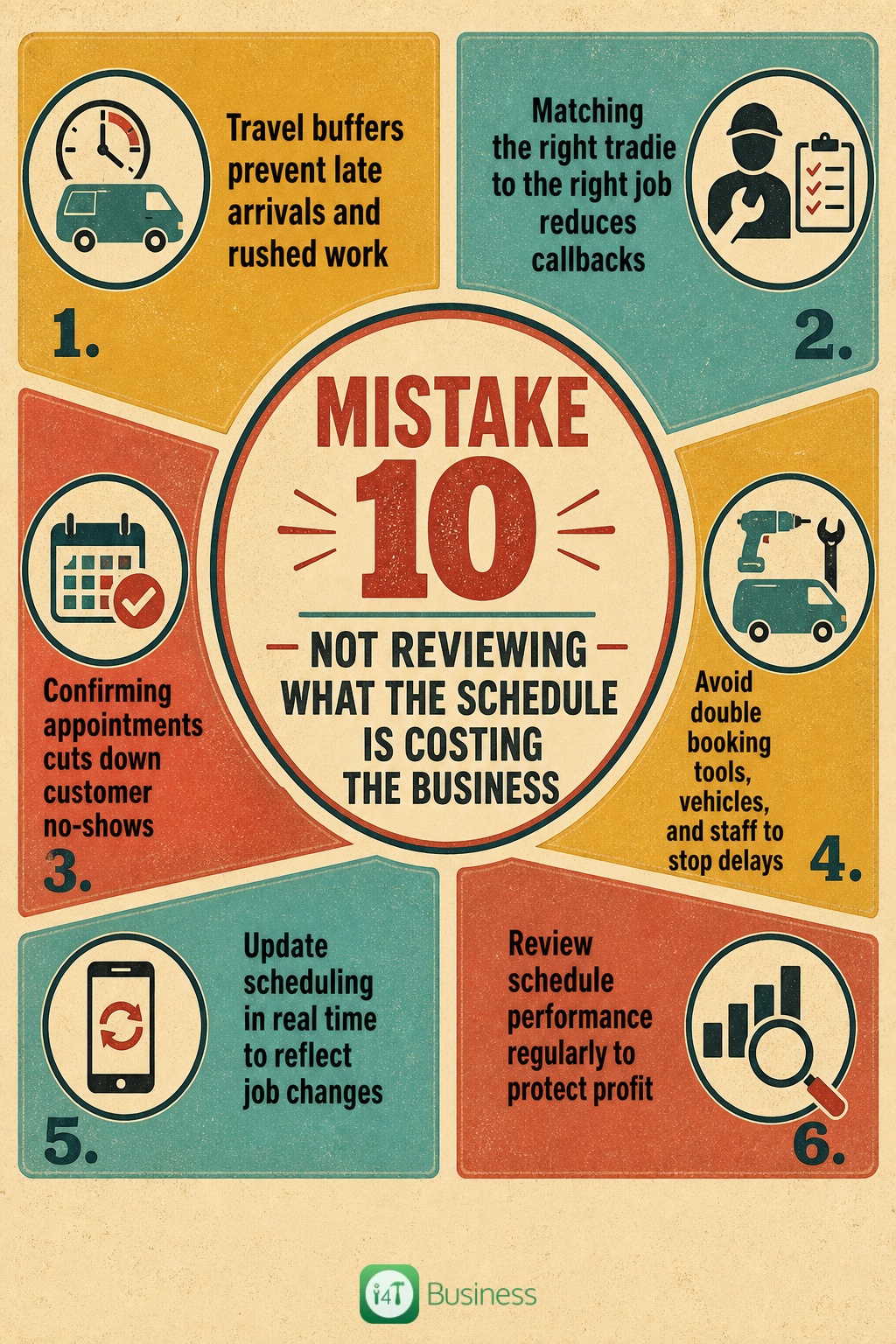
- Travel buffers prevent late arrivals and rushed work
- Matching the right tradie to the right job reduces callbacks
- Confirming appointments cuts down customer no-shows
- Avoid double booking tools, vehicles, and staff to stop delays
- Update scheduling in real time to reflect job changes
- Review schedule performance regularly to protect profit
How Better Job Scheduling Helps Tradies Win Back Time
Improving job scheduling isn’t about working harder, it’s about working smarter. Using one shared schedule makes sure everyone is on the same page, cutting confusion and constant rechecking. Adding buffers between jobs and grouping nearby sites means travel time is realistic and less stressful.
Confirming appointments with customers keeps no-shows to a minimum and clears up access details before the tech arrives. When scheduling, matching each job to the right skillset and equipment drastically reduces callbacks and delays. Preparing parts and materials beforehand lowers the chance of wasted trips for missing gear.
Leaving some space for urgent jobs prevents the whole day from becoming a scramble. Plus, keeping the schedule dynamic – updated from the field in real time – means the office and team can adjust quickly to changes. Finally, regularly reviewing the schedule’s productivity helps tradies spot where time or profit is leaking away and fix it.
Together, these steps transform job scheduling from a source of stress to a tool that helps take control, reduce chaos, and get more done every day.
When Should a Trade Business Use Job Management Software?
If your trade business has multiple team members, juggles more than a couple of jobs daily, or you find yourself constantly rescheduling and hunting for lost job notes, it’s likely time to consider job management software. Signs include delayed invoicing, customers calling to ask where their tradie is, or office staff drowning in admin.
Job management software like i4T Business, brings everything into one system — from scheduling and dispatching to storing customer details, managing job notes, creating quotes, invoices, and even collecting field updates. This real-time, all-in-one approach prevents many mistakes caused by fragmented information and manual processes.
Start your trial today.
Frequently Asked Questions
Job scheduling for tradies means organising when and where jobs happen, making sure the right tradie, tools, and parts are allocated on time to get the work done efficiently.
The biggest mistake is not allowing enough travel and buffer time between jobs, leading to late arrivals, rushed work, and a domino effect on the day’s schedule.
Using one shared job scheduling system that tracks people, vehicles, tools, and equipment helps tradies avoid double bookings and keeps the workday organised.
It depends on distance and job type, but generally 15 to 30 minutes between jobs works well to cover travel, site access, and any unexpected delays.
Yes, especially as your business grows beyond a couple of jobs daily or several team members, it helps streamline scheduling, reduces mistakes, and saves admin time.