
If you run a trade or field service business in Australia, 2026 is shaping up as a turning point. Costs are going up, good staff are hard to find, and customers expect instant updates and fast fixes. On top of that, technology is moving fast, especially around field service automation trends and AI in field service management.
The tradies who win won’t just be the ones who work the hardest. They’ll be the ones who use smart tools and job management software to work smarter; cutting admin, sharpening scheduling, and giving customers a smoother experience from first call to final invoice.
Here’s a breakdown of the key field service industry trends for 2026 and what they mean for your business.
1. From Simple Automation to Autonomous, “Agentic” AI
In the past, automation meant basic rules like “send a reminder the day before a job”. In 2026, AI goes a step further. It can look at your data, make suggestions, and even take action across your workflows without you clicking every button.
Instead of just helping with a single task, modern AI in field service management acts more like a smart assistant: it can pull together information from different parts of your system and help you manage your day, your techs and your customers.
- AI can recommend the best technician for each job based on skills, location and history
- It can trigger follow-ups, reminders and renewals automatically, so nothing slips through the cracks
- It can draft emails, job notes and reports based on the information already in your system
- It can spot patterns in recurring issues and recommend preventative actions
2. AI-Powered Scheduling and Dispatch Gets Seriously Smart
Scheduling has always been a headache: matching techs to jobs, managing travel time, and handling emergencies on top. With smarter scheduling tools, this is one of the biggest field service automation trends for 2026.
AI-driven scheduling can weigh up hundreds of factors in seconds. That means better use of your team, less time wasted on the road, and fewer unhappy customers waiting around.
- Jobs are allocated by skills, licences, location and urgency, not just “who’s free”
- Routes are optimised to reduce travel time and fuel costs
- Emergencies can be slotted in with minimal disruption to planned work
- Dispatchers can focus on exceptions and customer care, not dragging jobs around a calendar
3. Predictive Maintenance Becomes the New Normal
Another key theme in field service industry trends 2026 is the move from reactive to predictive maintenance. Instead of waiting for equipment to fail or servicing on a fixed schedule, businesses use data from sensors and past jobs to predict when things are likely to go wrong.
This trend is especially important for trades that deal with critical systems like HVAC, refrigeration, pumps, industrial equipment and solar. Predictive approaches can reduce downtime for clients and create steadier, more reliable work for your team.
- Equipment performance data can trigger jobs automatically before failure
- Service histories can highlight recurring issues and guide better repairs
- Maintenance plans can be tailored to real-world usage, not just generic schedules
- Customers see you as a proactive partner, not just someone they call when things break
4. Customer Self-Service Portals and Real-Time Visibility
Customers no longer want to call, leave a voicemail, and hope for the best. They’re used to tracking parcels, food delivery and rides in real time. That expectation is now hitting tradies and field service businesses.
Self-service portals are becoming a core part of field service automation trends. They give customers a simple way to engage with you without clogging up your phone lines or inbox.
- Customers can book jobs online at any time, without waiting for office hours
- They can approve quotes and variations digitally, speeding up decision-making
- Real-time “tech is on the way” updates reduce “where are you?” calls
- Online payment options make it easier to get paid faster
5. Mobile-First, “Supercharged” Technicians
By 2026, the smartphone or tablet will be the technician’s main work tool. A strong field app turns your techs into true professionals on site, giving them everything they need to do the job right the first time.
This is where AI in field service management really starts to shine in the field. It’s not just about office automation; it’s about making life easier for the people on the tools.
- Techs can see their schedule, job details and maps in one place
- They can access asset history, manuals, photos and previous issues while on site
- Compliance forms, SWMS and checklists are completed and stored digitally
- Quotes, invoices and photo reports can be created on site, reducing double-handling back at the office
6. AR, Remote Support and Virtual “Over-the-Shoulder” Help
Australia’s size means travel time can easily eat into your profit. One of the emerging field service industry trends 2026 is the use of augmented reality (AR) and remote support to cut down unnecessary trips and speed up tricky jobs.
With AR and video support, senior techs or specialists don’t always need to be on site. They can guide juniors through complicated fixes from the office, seeing exactly what they see.
- Junior techs can get live guidance from experienced staff without waiting for them to travel
- Experts can support multiple jobs a day without leaving the depot
- Remote diagnostics can help decide whether a visit is actually needed
- Some inspections and checks can be offered as a remote service for clients
7. Data-Driven Decision Making and KPI Focus
In 2026, data becomes the backbone of how field service businesses are run. Rather than relying purely on gut feel, owners and managers look at clear numbers to guide decisions.
Modern job management systems make this practical, not painful. They turn job data into dashboards and reports you can understand at a glance, even if you’re not a “numbers person”.
- Track first-time fix rate, average job time and travel vs labour ratio
- See which job types, suburbs or clients deliver the best profit
- Identify your top-performing techs and where others need extra support
- Spot trends in call-backs, complaints or unpaid invoices early, before they become bigger problems
8. Security, Compliance and “Secure-by-Design” Platforms
As more of your business moves into the cloud, job data, contacts, site photos, access instructions, security and compliance become more important. This is especially true if you deal with high-value properties, commercial sites or government work.
In 2026, security isn’t just “set and forget”. It’s a key part of how you choose your systems and how you win bigger contracts.
- Clients will increasingly ask how you protect their data
- Role-based access helps make sure staff only see what they need to see
- Audit trails show who did what and when, helping with disputes and compliance
- Secure integrations reduce the risk of data leaks between systems
9. Low-Code and Configurable Workflows for Every Trade
Every trade has its own way of doing things. A one-size-fits-all system can slow you down instead of helping. That’s why more platforms are going down the “low-code” or highly configurable path, a growing theme in field service automation trends.
This lets you shape the system around your business instead of twisting your process to match the software.
- Build custom forms and checklists specific to your trade or client requirements
- Set up job types and templates with the fields you actually need
- Create automations and triggers around your real-world workflow
- Design dashboards that highlight the numbers that matter most to you
10. Sustainability and “Green” Field Service Operations
Sustainability is no longer just a buzzword. It’s something more customers expect, and it’s a growing part of tenders and contracts, particularly for commercial and government work.
For field service businesses, sustainability lines up nicely with efficiency. When you waste less fuel, paper and time, you usually save money too.
- Route optimisation helps cut down on unnecessary driving and fuel use
- Digital forms and reports reduce paper and storage clutter
- You can track equipment efficiency and recommend greener options to clients
- Environmental data and reports can help you stand out in competitive tenders
How Aussie Tradies Can Get Ready for 2026
Looking across all these field service industry trends 2026, one thing is clear: trying to manage everything with spreadsheets, paper diaries and group chats won’t cut it for much longer. The good news is you don’t have to do everything at once.
A practical plan is to get your foundations right, then gradually layer in automation, AI and more advanced tools as your team gets comfortable.
- Start by mapping your current workflow from enquiry to invoice and noting bottlenecks
- Replace paper and spreadsheets with a central job management system
- Roll out a solid mobile app so techs can do everything from the field
- Turn on simple automations first (reminders, recurring jobs, follow-ups), then explore AI features
Why i4T Business Is a Smart Move for 2026
If you want to keep up with field service automation trends and make the most of AI in field service management without turning into an IT expert, you need software built specifically for tradies.
i4T Business Job Management Software is designed to be that backbone for Australian field service businesses. It helps you run smoothly today and get ready for the changes coming in 2026 and beyond.
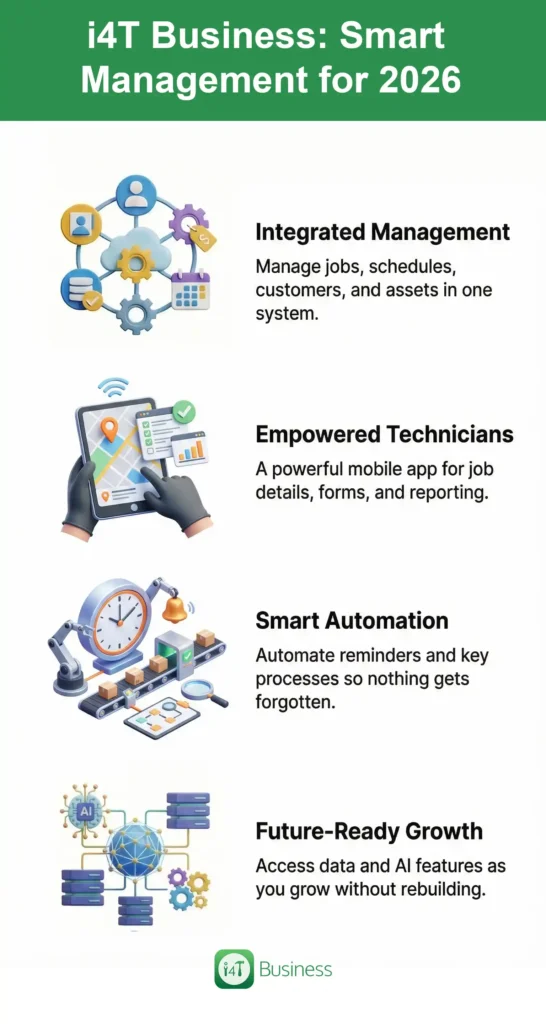
- Manage jobs, schedules, customers and assets in one integrated system
- Give your techs a powerful mobile app for job details, forms, photos and reporting
- Automate reminders, follow-ups and key processes so nothing gets forgotten
- Tap into data and AI-powered features as you grow, without rebuilding your whole setup
Ready to Stay Ahead of the Trends?
You don’t need to implement every new idea overnight. But you do need to start moving in the right direction now, before 2026 sneaks up on you.
If you want to future-proof your business and ride the wave of field service industry trends 2026 instead of getting swamped by them, it’s a great time to take the next step.
Book a demo of i4T Business Job Management Software and see how you can future-proof your business.
FAQs
No. Many of these tools are built with small and mid-sized tradie businesses in mind. Smaller teams can often roll out changes faster and see big wins quickly.
Not at all. Focus first on getting your jobs, schedules and data into one system. Once that’s in place, adding AI-driven features is much easier.
i4T Business gives you a modern platform that supports today’s needs while positioning you to take advantage of field service automation trends and AI in field service management as you’re ready.
That’s completely normal. The key is choosing software that’s simple and mobile-friendly. Start with the basics (job cards, scheduling, photos) and introduce new features slowly. Short training sessions and clear “how-to” steps go a long way.
Most businesses start seeing wins within a few weeks – fewer missed jobs, less double-handling and better visibility of what’s happening each day. Bigger gains, like stronger reporting and smarter automation, build over the next few months as your data and processes bed in.
Hot off the press!