
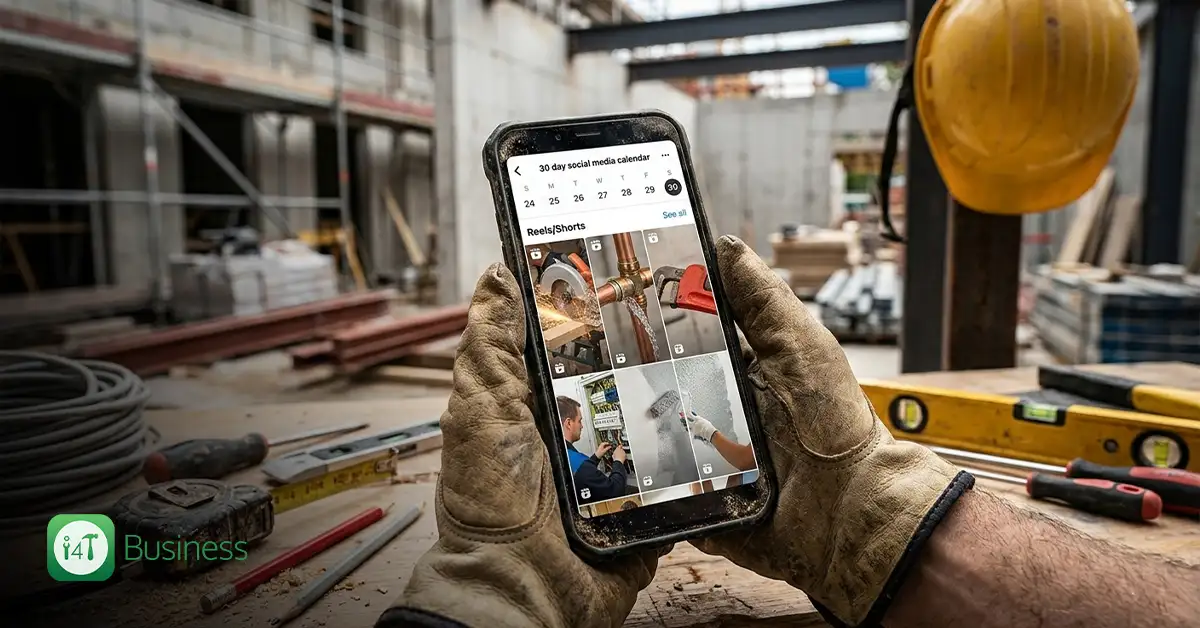
TL;DR
The easiest approach is to document what you already do: capture before-and-after photos, add a quick in-progress clip, and post consistently using a simple monthly plan. Done right, short-form video builds trust fast because customers can see your workmanship, cleanliness, and standards before they ever call.
- Use a repeatable Reel structure: Before, During, After, Benefit, and Call to action
- Build content around real work with before-and-after job photos, quick explainers, and process proof
- Stick to a realistic posting rhythm: 4-6 posts per week, reused across platforms
- Protect privacy: ask permission and avoid faces, house numbers, number plates, or identifying details
- Keep marketing honest and clear
- Make it easy long-term: follow a quick on-site photo routine and store photos in your job management system.
If you’re a tradie, you don’t need to become a full-time “content creator” to do well on social media. You just need a simple system that turns real jobs into short, clear proof that you’re reliable, tidy, and know what you’re doing. That’s why Reels, Shorts, and quick vertical videos work so well for trade businesses: they’re fast to make, easy for customers to understand, and perfect for showing before-and-after results.
In this guide, you’ll get a 30 day social media content plan for tradies built around real job photos, plus reels ideas for electricians and plumbers that don’t feel awkward or forced. You’ll also learn how to capture and store job photos so posting stays easy even when you’re flat out.
What should tradies post if they’re not “content people”?
The easiest approach is to document the work. Customers don’t need fancy edits. They want reassurance. They’re asking themselves: will this person show up, do it safely, and treat my place with respect? Your content should quietly answer those questions.
Most tradies get the best results by rotating three simple content types.
First, transformation content. This is where before-and-after job photos content ideas for tradies do the heavy lifting. A clean before shot, a clear after shot, and one line explaining the benefit is often enough to earn trust.
Second, quick explainers. Short videos that answer common customer questions are perfect for Reels and Shorts. You’re not teaching the trade, you’re showing that you understand the problem and can fix it properly.
Third, process proof. This is the behind-the-scenes stuff that signals quality: neat cable runs, tidy pipework, testing and checks, clean work areas, and a proper finished look.
Can you use real job photos legally and safely in Australia?
Yes, but build one habit: get permission and avoid personal details.
The OAIC explains that photos and videos can be treated as personal information under the Privacy Act if someone’s identity is clear or could reasonably be worked out. That can include faces, house numbers, nameplates, car number plates, or anything that makes the household identifiable.
A tradie-friendly way to handle this is simple:
- Ask the customer if you can take and post before-and-after photos
- Keep the shot on the work, not the person or the property details
- If there’s any chance it identifies them, don’t post it or blur it
A quick permission line you can use on-site is: Would you be okay if we take a couple of before-and-after photos for our socials? We won’t show any personal info like your address.
How do you turn job photos into Reels/Shorts quickly?
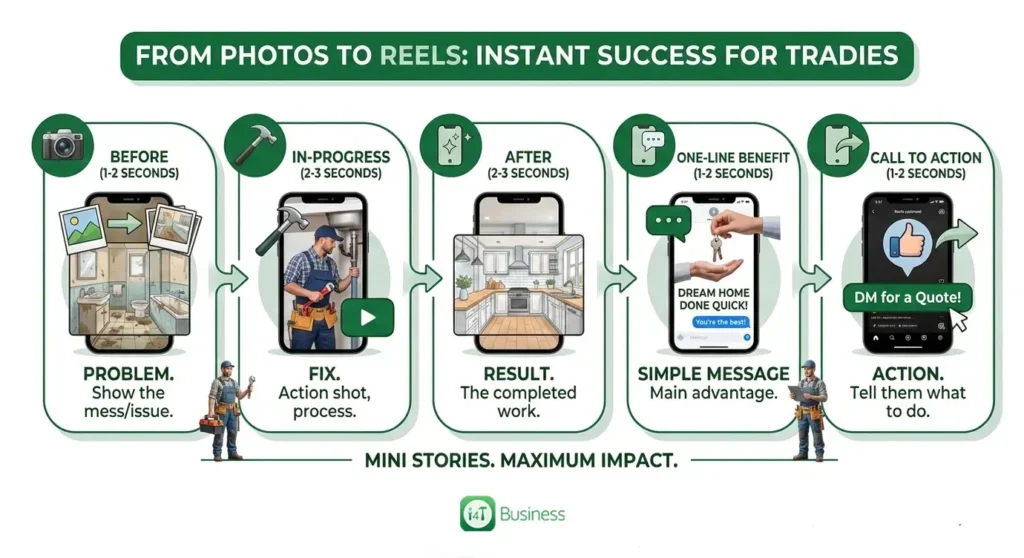
Think of each Reel as a mini story: problem, fix, result.
A clean 10–15 second format that works for tradies is: Before (1–2 seconds), one quick in-progress clip (2–3 seconds), After (2–3 seconds), one-line benefit (1–2 seconds), call to action (1–2 seconds).
Keep the text on screen simple. Most people watch with the sound off. And don’t stress about being perfect. Clear beats clever.
Reels ideas for electricians and plumbers that feel natural
If you want reels ideas for electricians and plumbers that genuinely bring in enquiries, start with what customers already ask you every week.
For electricians, job-based clips like switchboard upgrades, downlight installs, power point replacements, fault finding, and safety checks work well. For plumbers, blocked drains, leaking taps, hot water swaps, pressure issues, and bathroom or kitchen fixes are always relatable.
A few formats that rarely miss:
- The quick before-and-after (with a tidy finish close-up)
- The problem found (show the issue and explain it in one sentence)
- The three signs post (general warning signs that suggest it’s time to call a pro)
- The what’s included post (what happens when someone books you)
- The standards post (what you always do that customers don’t see, like testing and checks)
If a topic could tempt unsafe DIY, keep your advice general and safety-first. That actually builds more trust.
How often should a busy tradie post?
Consistency matters more than volume.
A realistic target for most trade businesses is posting 4–6 times per week, then reusing the same video across Instagram, Facebook, TikTok, and YouTube Shorts. You’re not making more content, you’re getting more value from the same job.
The trick is to capture little bits during the week, then batch posts in one hit. Even 45 minutes once a week can keep you ahead.
What should captions say so people enquire?
A caption should make the job understandable to a homeowner in five seconds.
A simple structure is: what went wrong, what you did, the result, where you service, and how to book.
For example, the customer had a leaking tap that wouldn’t stop dripping. We replaced the worn parts and tested the pressure. Now it’s sealed properly and running smoothly. Servicing Inner West and surrounding suburbs. Message us for a quote.
Avoid long paragraphs. Keep it friendly, local, and clear.
How do you avoid dodgy claims or misleading marketing?
If you mention prices, offers, guarantees, or big promises, keep them accurate and clear.
The ACCC’s advertising and selling guidance focuses on avoiding misleading conduct and making sure advertising claims are truthful and not confusing. In practical terms, avoid sweeping claims you can’t always deliver, and don’t post price bait that doesn’t reflect a real job.
How do you protect your social accounts?
Treat your socials like a business asset.
The Australian Cyber Security Centre recommends using multi-factor authentication (MFA) and other steps to secure social media accounts. A simple setup that covers most tradie businesses is:
- Turn on MFA for every account
- Use strong, unique passwords (a password manager helps)
- Keep admin access limited to the people who need it
How to capture job photos that turn into content fast
If social posting keeps slipping, it’s usually not because you ran out of ideas. It’s because your photos are scattered across phones and camera rolls, and finding them feels like admin.
Use a quick photo routine on every job:
- Before the wide shot
- Before close-up
- One in-progress proof shot
- After a wide shot
- After a close-up of the finish
Do that, and you’ll always have before and after job photos content ideas for tradies ready to go, without thinking.
The 30-day social media content plan for tradies (built for Reels/Shorts)
This plan is intentionally repetitive. That’s the point. Customers love seeing the same kind of proof again and again, because it makes you feel consistent and dependable.
Days 1–7 are trust builders. Post a clean before-and-after, a quick what we’re fixing today clip, a tidy finish close-up, a time-lapse of setup or pack-up, a common problem you see, a simple service area post, and a best job of the week recap.
Days 8–14 are simple education. Share three warning signs (sparkies and plumbers can both do this safely in general terms), explain what’s included when someone books you, do a before-and-after with a one-sentence cause, myth-bust something customers assume, explain what affects pricing without quoting exact numbers, and finish the week with a short Q&A.
Days 15–21 are local credibility. Post a job in a suburb you service (without showing personal details), show a quick standards moment like testing or checks, share a maintenance tip, post a what we won’t do standards message, spotlight a part or product choice and why you use it, do a three-job montage, and introduce your team or how you work.
Days 22–30 are conversion. Show how to book, share a safety-first emergency tip, post a testimonial with permission, explain what happens after a quote is accepted, share availability only if it’s true, post a value message about clean work and long-term savings, do a month recap montage, share the most common jobs you handled, and finish with a strong before-and-after plus a clear call to action to message or book.
Make content easy by recording the job once
The easiest way to stay consistent is to make content a side-effect of doing the job properly. When your job details and before-and-after photos are saved against each job, posting becomes a quick pick-and-post task, not a late-night hunt through your camera roll.
That’s exactly where i4T Business helps. Use it for job recording and before-and-after photos, so you can build a tidy library of real work that turns into Reels and Shorts whenever you need it.
FAQs
Aim for 4-6 posts a week and reuse the same Reel across Instagram, Facebook, TikTok, and YouTube Shorts.
Before-and-after job photos. They’re quick, clear, and build trust fast.
Yes, but get permission and avoid showing personal details like faces, addresses, house numbers, or number plates.
Quick before/after, “problem found”, tidy finish close-ups, “3 warning signs”, and “what’s included when you book us”.
Use a photo routine on every job and store photos properly. i4T Business helps by saving job notes and before/after photos against each job, so you can post quickly later.
Hot off the press!