

TL;DR
Scheduling issues cost tradies real money through wasted drive time, no-shows, rework, and overtime. The 7 biggest scheduling mistakes are:
- Guessing job durations instead of using realistic time estimates
- Booking back-to-back jobs with no travel or contingency buffers
- Dispatching without geography, causing zig-zag driving and wasted hours
- Not confirming bookings properly, leading to no-shows and “not ready” sites
- Capturing poor job details, which triggers wrong parts and repeat visits
- Overbooking capacity, which pushes work into overtime and late finishes
- Constant last-minute schedule changes that create chaos and fatigue
Fixing these means tightening your booking rules, standardising job info, and protecting schedule stability. Using Job Scheduling Software in Australia, a tradie scheduling app, or field technician dispatch software can help automate reminders, improve dispatching, and keep everyone on the same page.
A full diary should feel like a win. But for heaps of Australian tradies, a “booked out” week still ends with late finishes, stressed techs, cranky customers, and margins that don’t match the effort.
That’s because scheduling is where the hidden costs live. Travel blowouts, no-shows, rework, overtime, and constant reshuffling all come straight out of your profit and your energy.
The upside is that most scheduling issues aren’t complicated. They’re usually the same handful of mistakes repeating in different ways. Fix the pattern, and suddenly the same team can complete more work with fewer headaches.
Here are the 7 scheduling mistakes that commonly cost tradies thousands, and what to do instead.
You’ll also see where Job Scheduling Software in Australia, a solid tradie scheduling app, or field technician dispatch software can make these fixes easier to run consistently.
Why do days blow out even when you planned them well?
Mistake tradies make: Guessing job durations instead of scheduling off real time estimates.
This is the big one. When every job gets a default slot, your schedule becomes optimistic instead of accurate. A “quick fix” turns into fault-finding. A standard install turns into a half-day because access is tight or the previous work is messy. Then the entire day slides.
The real cost isn’t just the extra hour. It’s the knock-on effects: you arrive late to the next job, the customer loses trust, and you either rush workmanship or push work into after-hours admin. Over time, the team gets used to running behind, and you start building your week on stress.
What to do instead: Start building a simple “duration library” based on your real jobs. Keep it practical, not perfect. Pick your top 10 job types and set a baseline time, then add a consistent loading for common complications like difficult access, strata rules, or regional travel.
How can a “fully booked” day still feel like chaos?
Mistake tradies make: Booking back-to-back jobs with no buffers for the real world.
Even a smooth job has edges around it. Parking. A quick run to the ute. A call to the wholesaler. A customer chat. Photos for the record. A safety check with the apprentice. When your calendar has zero breathing room, those small realities turn into delays, and delays turn into blowouts.
This is also where fatigue quietly creeps in. If every day is set up to run late, people cut corners, skip breaks, and lose focus. Safe Work Australia highlights fatigue as a workplace risk that needs managing through practical controls, and scheduling is one of the biggest controls you’ve got.
What to do instead: Build buffers into the rules of your schedule.
- Add a travel buffer between jobs, even if it feels small
- Add a contingency buffer to jobs that frequently run long
Once buffers are “standard”, you stop relying on luck to have a good day.
Why does your crew spend so much time driving instead of earning?
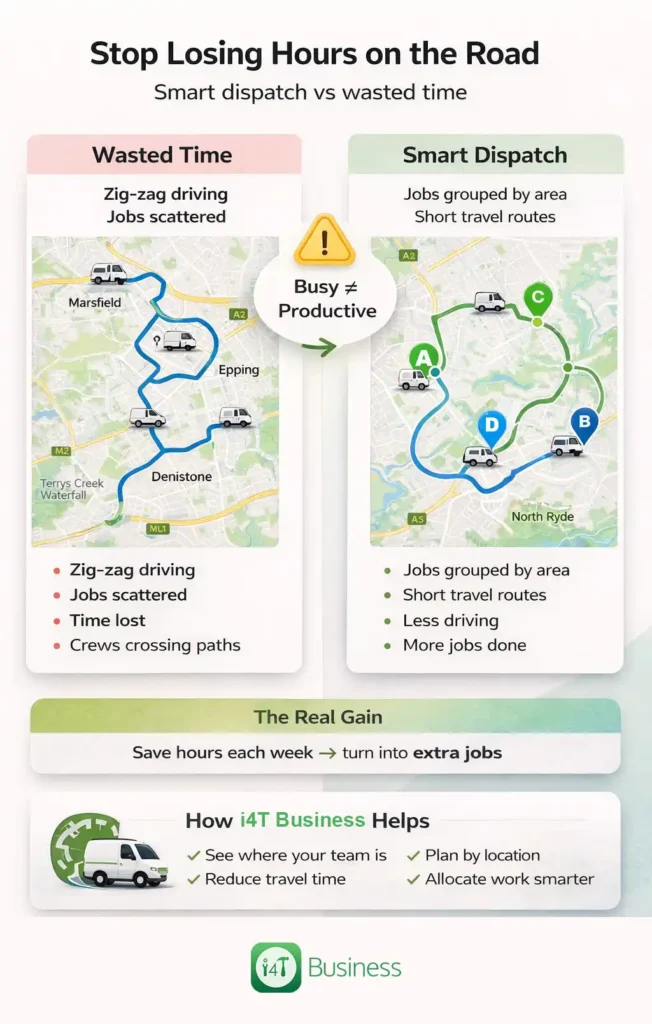
Mistake tradies make: Dispatching without geography, so techs zig-zag across suburbs all day.
This is one of the easiest ways to lose money without noticing. You might be busy all day, but the hours are leaking out through windscreen time. It also creates poor handovers and more “where are you up to?” calls, because everyone’s scattered.
Dispatching based on who is “free next” feels logical in the moment, but it often creates the worst overall outcome. Two jobs in the same area, scheduled smartly, can save an hour or more. Across a week, that becomes extra capacity you can actually sell.
What to do instead: Schedule in zones and runs. Group work by area and type where possible, and avoid crossing crews over unless there’s a strong reason. This is exactly where field technician dispatch software helps, because it gives you a clear view of who is where, what’s next, and how to allocate work without guesswork.
Why do no-shows and “not ready” jobs keep wrecking the day?
Mistake tradies make: Not confirming properly, and not setting a simple pre-visit checklist.
Most no-shows aren’t customers being difficult. It’s usually a broken process. The tenant didn’t get the message. The customer forgot. Access wasn’t arranged. The quote wasn’t approved. The power is off. The dog is loose. You arrive and can’t do the work.
That costs more than just the missed slot. It also costs your ability to backfill that time with another job, because you only find out at the last minute.
What to do instead: Make confirmation automatic and consistent.
- Confirm at booking, remind the day before, and send an arrival window on the day
- Include a short “ready” note: access, approvals, pets, parking.
A good tradie scheduling app can send these messages automatically so they happen even when you’re flat out.
Why do small jobs turn into repeat visits and wasted time?
Mistake tradies make: Booking jobs with incomplete details, so techs show up unprepared.
If the booking says “hot water issue” but you don’t know the brand, symptoms, age of unit, location, or what’s been tried already, you’re walking in blind. That usually leads to longer diagnosing on site, extra calls for advice, or a second visit with the right parts.
It’s not just the time on site either. It’s the extra admin, extra travel, and the customer’s confidence dropping because you feel reactive rather than prepared.
What to do instead: Standardise your minimum job information. Keep it simple and repeatable: access notes, key equipment details, clear problem description, photos when useful, and parts status. When this is built into your scheduling workflow, every job becomes smoother, even when it’s tricky.
Why does overtime sneak up even when you’re “managing fine”?
Mistake tradies make: Overbooking capacity, then pushing work into overtime or penalty windows.
A lot of tradie businesses schedule based on the number of jobs, not total crew-hours. Two “small jobs” can easily become four hours once you factor in travel, setup, customer talk, and surprises. Then you’re finishing late, and the late finish becomes normal.
If you employ staff, overtime and penalty conditions depend on the relevant award or agreement, and overtime can become a real cost when it’s frequent or unplanned. Fair Work Ombudsman provides guidance on overtime pay and how it applies in different circumstances.
Penalty rates information is also available.
Even for owner-operators, the “cost” shows up as less quoting time, less recovery, and more mistakes.
What to do instead: Plan the day using crew-hours. Set a realistic cap for each tech based on travel and admin. Protect one flex slot for urgent work so you don’t blow up the whole schedule when something pops up.
Why does constant rescheduling create bigger problems than it should?
Mistake tradies make: Treating every change as urgent, which creates chaos and fatigue.
When the schedule shifts all day, the team never settles into a rhythm. Apprentices don’t know what they’re walking into. The office spends the day rearranging instead of improving the system. Customers get mixed messages. Techs lose confidence in the plan and start improvising in the van.
This is also where fatigue risk can rise. Long days, irregular hours, and constant mental load can affect focus and safety. Safe Work Australia’s fatigue risk guidance is worth reading because it makes clear that fatigue is manageable when you put controls in place, and better scheduling is one of those controls.
What to do instead: Stabilise tomorrow, today. Set a cut-off time where the next day’s schedule is locked unless it’s a genuine emergency. Keep a short list of flexible customers who are happy to take an earlier slot if a gap appears.
Fix the schedule, protect the profit
These seven mistakes are common because trade work is busy, unpredictable, and human. But once you tighten the process, you’ll feel it quickly: fewer blowouts, fewer angry calls, and more work completed in normal hours.
If you want these fixes to run without relying on memory and sticky notes, i4T Business helps you manage technician scheduling with a clear calendar, smart dispatching, job cards, and customer updates. It’s built to support the way tradies actually work, so you spend less time reshuffling and more time getting jobs done cleanly and on time.
Book a demo.
FAQs
Guessing job durations and booking jobs into unrealistic time slots.
Confirm every booking and send reminders with a simple access and readiness checklist.
Grouping jobs by area cuts drive time, fuel costs, and daily blowouts.
A basic calendar works early on, but once you’re juggling multiple jobs or techs, software helps with dispatching, updates, job notes, and reminders.
Drag-and-drop scheduling, easy dispatch, job cards with notes/photos, automated reminders, and mobile updates from the field.
Hot off the press!