
If you’re running a small business in Australia, whether as a tradie, freelancer, consultant, or agency, getting paid on time is crucial. One of the best ways to make this happen is by having clear invoice terms and conditions. These are the rules and guidelines you set on your invoices about when and how payments should be made, what happens if payments are late, and other important details.
This article provides a practical Invoice terms and conditions template for Australia and a free checklist you can use right away. We’ll walk you through what to include in your invoice terms, why these terms matter, and offer examples tailored to different types of Australian businesses. Just a quick note: this article offers general information only and does not replace professional legal, tax, or financial advice.
What are invoice terms and conditions?
Invoice terms and conditions are the specific rules you attach to an invoice that explain how the payment should be made and what your client can expect. They’re not the same as a contract, which is usually a separate document outlining broader project scopes, responsibilities, and timelines. Nor are they the same as a quote, which is an estimate of cost before work starts.
Instead, invoice terms focus on payment details once the work has been completed or milestones reached. Having these terms agreed upon before any work begins helps avoid confusion later. It sets everyone on the same page regarding when the payment is due, how to pay, and any consequences if payments are late. This clarity is essential in avoiding disputes and ensuring your cash flow stays healthy.
Why clear invoice terms matter for Australian businesses
Clear invoice terms are the backbone of smooth financial transactions for small businesses in Australia. They help maintain positive customer relationships by setting upfront expectations. For example, a tradie who clearly states payment is due within 14 days can follow up on late payments confidently, knowing the customer was informed from the start.
Furthermore, clear terms improve professionalism. Customers see that you run your business properly when invoices contain all the necessary details, including your ABN and payment options. This can encourage faster payments and reduce the chances of disputes.
From a cash flow perspective, predictable payments mean you can plan your expenses better rather than chasing overdue accounts. Lastly, clear terms make debt recovery easier should you ever need to involve third parties. The ACCC and the Australian Small Business and Family Enterprise Ombudsman recommend having transparent payment terms as a best practice for Australian companies.
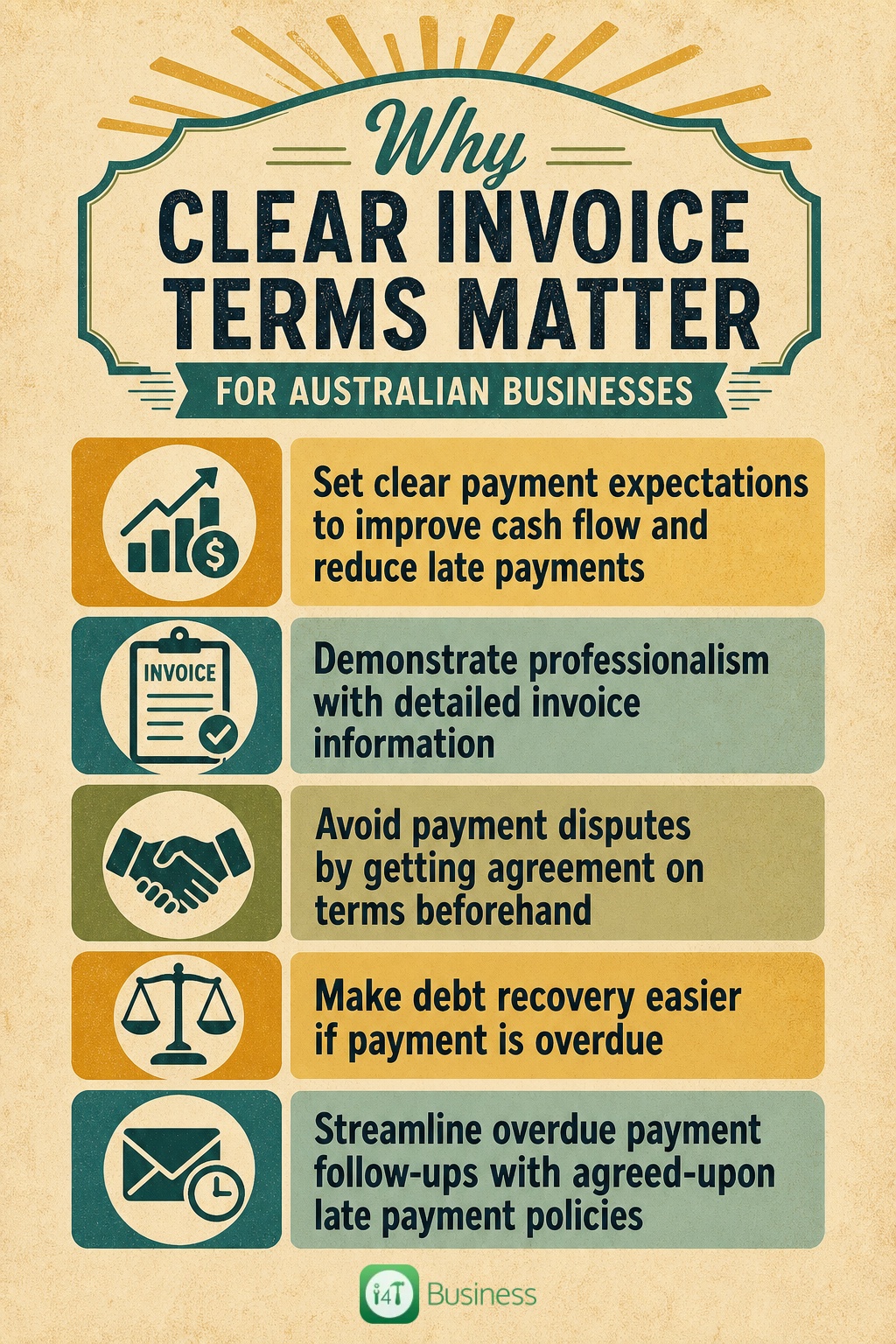
- Set clear payment expectations to improve cash flow and reduce late payments
- Demonstrate professionalism with detailed invoice information
- Avoid payment disputes by getting agreement on terms beforehand
- Make debt recovery easier if payment is overdue
- Streamline overdue payment follow-ups with agreed-upon late payment policies
Free invoice terms and conditions checklist for Australian businesses
When creating your invoice terms, make sure your invoice covers all the key details that help your customer understand what’s expected. Start with your business name and ABN; this confirms your legitimacy and is often required on Australian invoices. Include your customer’s correct contact details so there’s no delay in their processing.
Your invoice number and date help both parties track payments and records. The due date is critical; this tells the customer exactly when payment is expected. Clearly state what payment methods you accept; bank transfer, credit card, or other options — and how to include the right payment reference to avoid confusion.
Show the GST clearly if you’re registered for it, including whether prices include GST or not, along with a proper description of the products or services provided. The total amount payable should be easy to spot.
Don’t forget to explain your late payment process; will you charge interest, send reminders, or pause work? Outline how disputes will be handled to discourage delays in payment.
If you require deposits or milestone payments, these should have separate terms. Include policies on cancellations, scope changes, and specify the ownership of goods or deliverables until full payment is received. Finally, note any debt recovery steps you may take if payment isn’t received.
Invoice terms and conditions template in Australia
Here’s a simple wording template Australian businesses can adapt to suit their needs:
“Payment is due within 14 days of the invoice date unless otherwise agreed in writing. Payment can be made via bank transfer, credit card, or PayPal. Please include your invoice number as the payment reference to ensure prompt processing.“
“A deposit of 20% is payable before work commences, with the balance due on completion. Milestone payments will be invoiced at agreed stages.“
“Prices include GST where applicable. We are registered for GST (ABN: 12 345 678 901).“
“Late payments may attract a fee of 2% per month on the outstanding amount, compounding monthly, with prior notice given.“
“If you have a dispute with this invoice, please contact us within 7 days so we can resolve the matter promptly.“
“Ownership of goods and deliverables remains with us until full payment has been received.“
“Any cancellations or changes to scope must be notified in writing and may incur additional charges.“
“This invoice and its terms are governed by the laws of New South Wales, Australia.“
Invoice terms for different business types
Freelancers and consultants: Focus on clear scope descriptions and milestones. You might include terms around intellectual property ownership until full payment and conditions for revisions or additional work.
Tradies and construction businesses: Deposits and milestone payments are common. Your terms should address cancellations, scope changes due to site conditions, and lien rights if payments are overdue.
Agencies and creative studios: Emphasise revisions, approvals, and payment stages aligned to project phases. Late payment consequences are important where cash flow depends on retainer or staged billing.
Ecommerce businesses: Clear refund and cancellation terms alongside payment methods are key. Consider digital delivery confirmation and ownership transfer upon payment.
SaaS or subscription businesses: Focus on terms around automatic payments, renewal cycles, and cancellation policies. Clear payment dates and access suspension clauses for overdue payments help maintain healthy cash flow.
What payment due date should you use?
Choosing the right payment due date depends on your business model and client relationships. Common terms you’ll see in Australia include “due on receipt,” 7 days, 14 days, and 30 days from invoice date. Some businesses use ‘end of month’ terms, meaning payment is due by the end of the calendar month in which the invoice was issued.
Shorter terms like 7 or 14 days encourage faster payment, which helps cash flow, but may not suit all clients. Longer terms like 30 days or more are typical for B2B transactions with trusted customers.
If you work on projects with milestones, include milestone payments with their own due dates. Similarly, deposits should be payable upfront. For instance, your terms might read, “A 20% deposit is due prior to work commencing, with the balance payable within 14 days following completion.”
Clarity is key. Avoid vague phrases like “payment due upon completion” without dates, or “net 30” without explanation, as this can lead to confusion.
GST, ABN and tax invoice details
If you’re registered for GST in Australia (business turnover above $75,000), your invoice must meet certain tax invoice requirements. This includes clearly showing your Australian Business Number (ABN), stating that the document is a tax invoice, and detailing the GST amount or including it in the total clearly.
Invoices should state if the prices include GST or if GST is added on top. This transparency avoids misunderstandings with customers and helps with your own tax reporting.
The Australian Taxation Office (ATO) provides guidelines on what a tax invoice must include, so it’s wise to review these to ensure compliance. Even if you’re not registered for GST, including your ABN on invoices is considered best practice as it identifies your business.
Can you charge late payment fees in Australia?
Yes, you can include late payment fees in your invoice terms in Australia, but these fees must be reasonable, clearly stated, and agreed upon upfront. Charging harsh or excessive fees can backfire, damaging customer relationships or risking disputes.
A 2% per month interest charge on overdue amounts is common, but make sure this is fair and clearly disclosed. Alternatively, many businesses protect themselves by asking for deposits, using milestone payments, setting shorter payment terms, or sending automated reminders before invoices become overdue.
Some businesses also temporarily pause work if payments are late, but this needs to be communicated clearly in the terms and handled professionally.
Common invoice terms mistakes to avoid
Too often, small businesses miss key details that lead to payment headaches. One common mistake is not specifying a clear payment due date. If your invoice doesn’t say when payment is expected, customers may delay indefinitely.
Vague descriptions of work or products make it hard for customers to verify what they’re paying for, increasing dispute risks.
Missing payment instructions, such as bank details or the correct payment reference, can delay processing. Ensure your invoice matches the terms agreed in your quote or contract to avoid confusion.
Adding late fees only after issues arise, without having them in initial terms, can lead to arguments.
Not including a clear dispute process may prolong non-payment. Finally, sending invoices to the wrong contact or email address can stall payments – always double check.
How job management software can make invoicing easier
For Australian small businesses juggling multiple jobs, clients, and payments, job management software can be a game changer. It helps keep quotes, job details, customers, invoices, and payment statuses all in one organised place.
Rather than manually tracking due dates and chasing payments, the software can automate invoice creation with your agreed terms, send reminders, and provide clear records if debts become overdue.
i4T Business Job Management Software is a practical choice that helps tradies, freelancers, consultants, and agencies across Australia improve their invoicing processes and reduce admin hassle. It takes out the guesswork and lets you focus on the job while keeping your payments on track.
Final invoice terms checklist before you send an invoice
- Include your full business name and ABN
- Show customer details and invoice number
- Clearly state invoice date and payment due date
- List accepted payment methods and reference instructions
- Display GST amounts or state GST-inclusive pricing
- Provide a clear description of goods or services
- Outline your policy for deposits, milestone payments, and cancellations
- Explain late payment fees and overdue payment process
- Include dispute resolution steps
- Mention ownership of goods until payment is received
FAQs
What are standard invoice payment terms in Australia? Generally, 14 to 30 days from the invoice date are common, with some businesses requesting payment on receipt or 7 days for faster cash flow.
What should I write in invoice terms and conditions? Include payment due date, accepted payment methods, GST details, late payment policy, dispute process, deposits, cancellations, and ownership of goods.
Can I use a free invoice terms and conditions template in Australia? Yes, free templates like the one in this article are a great starting point but should be customised to your business.
Can I charge late payment fees on overdue invoices? You can if the fees are reasonable, clearly stated, and agreed before work begins.
Should my invoice say tax invoice? If you’re registered for GST, yes. This label ensures it meets ATO requirements for business clients claiming GST credits.
Do I need to include my ABN on an invoice? Including your ABN is highly recommended and often required for GST-registered businesses.
Are invoice terms legally binding in Australia? Yes, if agreed upon or incorporated into contracts, invoice terms form part of the payment agreement.
What should I do if a customer does not pay an invoice? Start with reminders referencing your payment terms, then escalate responsibly, potentially seeking advice or debt recovery if necessary.
Should invoice terms match my quote or contract? Absolutely. Consistency avoids confusion and reinforces payment expectations.