


//
Share this article

Table of Contents

8 Numbers Every Trade Business Should Review Before EOFY

8 Numbers Every Trade Business Should Review Before EOFY

Table of Contents

Key Takeaways

  • Reviewing KPIs before EOFY ensures your trade business stays on track financially and operationally.

  • Gross profit margin reveals how well you convert materials into profit, while net profit margin shows overall financial health.

  • Accurate job costing and managing outstanding invoices enhance profitability and cash flow.

Key Answer

Reviewing your trade business KPIs before EOFY is crucial. Focus on metrics like gross profit margin, net profit margin, and job costing accuracy to ensure your business remains profitable and efficient.

As the End of Financial Year (EOFY) looms, it’s a prime opportunity for every trade business to assess performance and set a course for the year ahead. Understanding your tradie business KPIs is crucial to not just surviving but thriving in the competitive Australian market. These metrics offer a clear snapshot of where you stand financially and operationally, allowing you to make informed decisions that boost both efficiency and profitability.

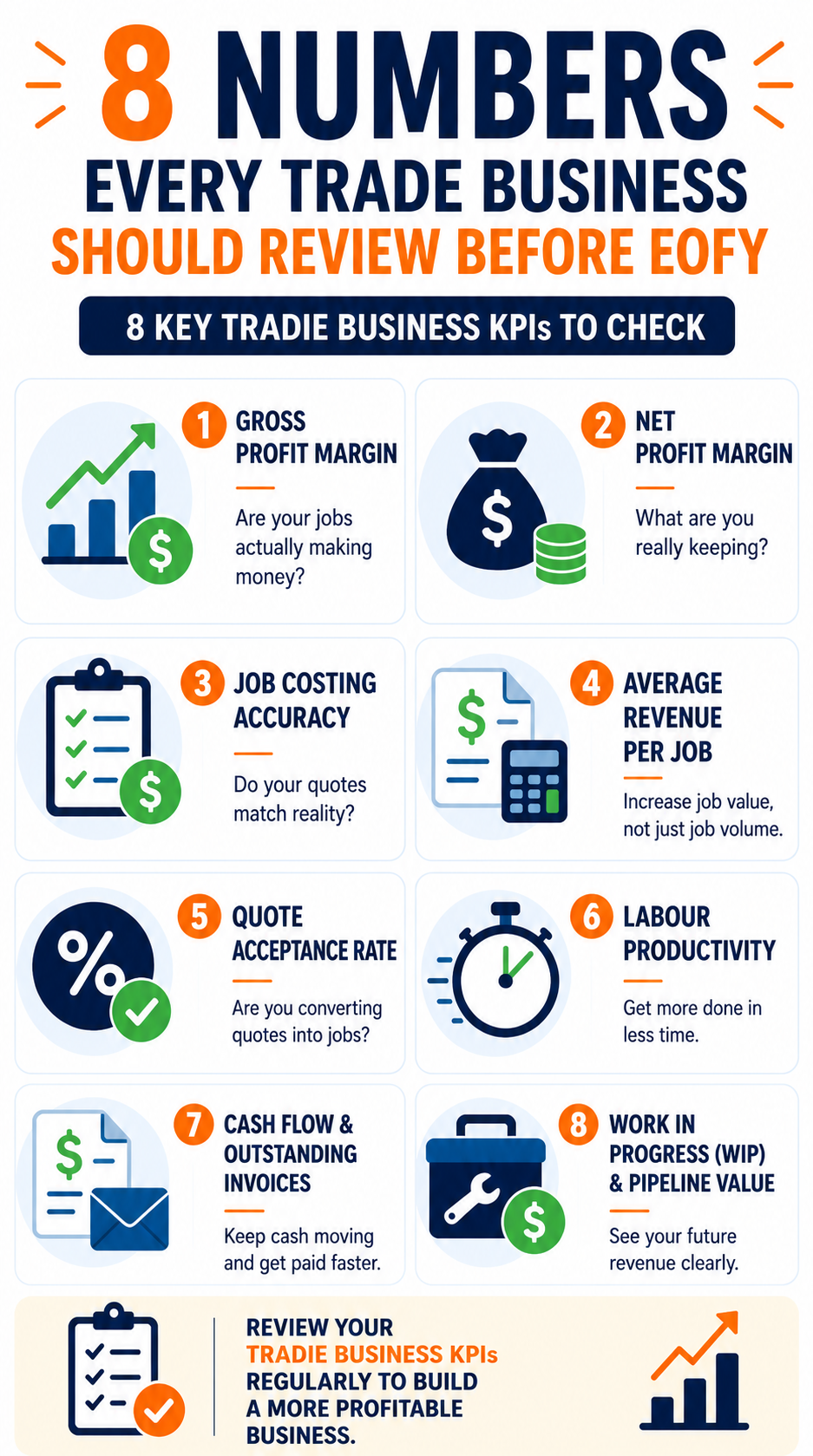
By focusing on eight key numbers, from gross profit margin to work in progress values, you can ensure your business is on a solid footing. The importance of these figures cannot be overstated; they guide strategic planning, cash flow management, and competitive positioning. So, let’s dive into the essential numbers you need to review before the EOFY to keep your trade business on track.
XYt5XpWkev8AoPw18NnEcFCt0ZRavj2t31Q5yiyB.png

1. Gross Profit Margin: The Profitability Indicator

Your gross profit margin is a crucial indicator of your business’s profitability. Calculated as the difference between sales revenue and the cost of goods sold, it reveals how efficiently you’re converting raw materials into profit. A strong margin signals healthy operations, while a weak one may suggest high production costs or pricing issues.

To calculate this, subtract your cost of sales from your total revenue and divide the result by your total revenue. Aim for a margin that aligns with industry standards; for many Australian trades, this means shooting for at least 30%.

Common mistakes include underestimating the cost of goods sold or not accounting for all variable expenses. Regularly updating your pricing strategy based on material and labour costs ensures your margin remains robust.

Item

Formula

Benchmark

Gross Profit Margin

(Sales – Cost of Goods Sold) / Sales

30% or higher

2. Net Profit Margin: The True Bottom Line

While gross profit provides a snapshot, net profit margin tells the full story of your financial health by including all expenses. This KPI shows what percentage of sales revenue becomes actual profit after covering all operating costs, taxes, and interest.

To compute your net profit margin, subtract all operating expenses, interest, and tax from your total revenue, then divide by total revenue. Aiming for a net profit margin between 5% to 10% is common in the trade industry.

It’s critical not to overlook overlooked expenses such as utilities and insurance, which can skew your margin. Monitoring this figure helps identify areas where cost savings are possible, improving your bottom line.

Item

Formula

Benchmark

Net Profit Margin

Net Profit / Total Revenue

5% to 10%

3. Job Costing Accuracy: Precision in Pricing

Accurate job costing is essential for ensuring you’re not undercutting yourself on prices or overcharging clients. This involves thoroughly assessing all costs associated with a job, including labour, materials, and overheads.

Utilise job costing software to improve accuracy, enabling better tracking of expenses and minimising errors. This also aids in quoting accurately, which directly affects your profit margins.

Inaccuracies in job costing can lead to significant losses. Ensure that every quote reflects the actual cost by regularly auditing your expense reports and adjusting estimates based on past job performance.

4. Average Revenue Per Job: Maximising Efficiency

This metric indicates how much income each job brings in on average, providing insight into your business’s efficiency and pricing strategy. It’s calculated by dividing total revenue by the number of jobs completed.

A higher average revenue per job suggests effective upselling or premium pricing strategies. On the other hand, a lower figure might indicate the need to review your services or add-ons for potential value increases.

Benchmarking your average revenue against industry standards helps identify areas for improvement. Regularly evaluate your job offerings and client feedback to enhance service value and increase this KPI.

Metric

Formula

Goal

Average Revenue Per Job

Total Revenue / Number of Jobs

Competitive with Industry

5. Quote Acceptance Rate: Winning More Work

Your quote acceptance rate is a measure of how successful you are in converting quotes into jobs. A high acceptance rate suggests your pricing is competitive and aligns with client expectations.

To calculate, divide the number of accepted quotes by the total number of quotes issued. A rate above 50% is typically favourable in the trade sector, indicating strong client relationships and appropriate pricing strategies.

Improving this rate involves refining your sales techniques and ensuring quotes are clear and compelling. Review rejected quotes to understand why they weren’t successful, and adjust your approach accordingly.

6. Labour Productivity: Maximising Workforce Output

Labour productivity measures how efficiently your team completes tasks, calculated by the output per labour hour. High productivity indicates effective project management and skilled workers.

To boost productivity, consider investing in training or adopting job management software that streamlines processes and reduces downtime. It’s also crucial to evaluate task allocations and ensure resources are optimised.

Common issues that hamper productivity include poorly defined roles and inadequate resources. Regular team reviews and feedback sessions can help identify and resolve these problems, ensuring your business runs smoothly.

7. Cash Flow & Outstanding Invoices: Ensuring Liquidity

Cash flow is the lifeblood of any business, and outstanding invoices can severely disrupt it. Monitoring your cash flow ensures you have the liquidity needed to cover operational costs and reinvest in your business.

Keep track of debtor days – the average time it takes to get paid – and strive to reduce this figure. A debtor day count under 30 is ideal, ensuring consistent cash inflow.

Using software to automate invoicing and follow-up reminders can help manage and reduce outstanding invoices, improving cash flow. Regularly review your accounts receivable process to streamline collections.

8. Work in Progress & Pipeline Value: Future-Proofing Your Business

The value of work in progress (WIP) and your project pipeline are indicators of future revenue and business health. WIP accounts for jobs started but not yet completed, while pipeline value represents potential future projects.

Regularly reviewing these numbers helps ensure you have enough work lined up to maintain cash flow and business growth. Strive for a balance that avoids overextending resources while keeping the pipeline full.

Forecasting tools and job management systems like i4T Business can provide insights into your pipeline status and help prioritise projects, ensuring steady work and revenue. Book a demo today.

Frequently Asked Questions

Reviewing KPIs before EOFY helps you assess your financial and operational performance, enabling informed decision-making for the next financial year.

Job management software like i4T Business can help automate job costing and streamline invoice management.

To improve your quote acceptance rate, refine your sales techniques, ensure your quotes are clear, and regularly review rejected quotes to identify improvement areas.

A net profit margin between 5% to 10% is considered healthy for trade businesses.

Labour productivity affects your business by determining how efficiently your team completes tasks, impacting overall profitability.

Scroll to Top