
TL;DR
An automated quoting system helps you win more jobs by sending faster, clearer quotes that look professional and are easy to approve. It also reduces mistakes such as missed labour, materials, or GST, and improves follow-up, so fewer quotes get ignored.
Using quoting software for tradies/job estimation software in Australia means more accepted quotes and better margins.
If you’re a tradie in Australia, you already know the truth: doing great work is only half the battle. The other half is getting the job in the first place. And a lot of jobs are won or lost before you ever pick up a tool, right at the quoting stage.
Quoting is where things often fall apart. You finish a job, drive to the next one, take a call in between, and by the time you sit down to send quotes, it’s late, you’re tired, and the details are fuzzy. Some quotes go out slowly, some go out rushed, and some don’t go out at all. Meanwhile, customers are comparing options. They want a price that makes sense, a scope that feels clear, and a business that looks reliable. If they don’t get that quickly, they move on.
This is exactly where an automated quoting system helps. Instead of writing every quote from scratch, you can use templates, saved labour rates, standard line items, and pre-set terms. That means you can send cleaner quotes faster, keep pricing consistent, reduce mistakes, and follow up without relying on memory. In other words, quoting software for tradies doesn’t just reduce admin, it supports the things that directly help you win more jobs: speed, clarity, confidence, and professionalism.
Below are the 10 questions tradies usually ask when they’re looking at job estimation software in Australia and trade quoting software, with clear answers you can actually use.
What is an automated quoting system, and what does it actually do?
An automated quoting system is basically a smarter way to produce quotes without starting from a blank page every time. It gives you a structured framework so you can build accurate quotes quickly, even when you’re busy.
Instead of relying on memory, scattered notes, or whatever you typed last time, you’re pulling from saved items like labour rates, service packages, materials, call-out fees, travel charges, and standard terms. It’s especially handy if you quote similar job types regularly, like split-system installs, hot water replacements, switchboard upgrades, drain call-outs, or routine maintenance.
What this changes in the real world is consistency. Your quotes don’t depend on how tired you are, who wrote them, or how rushed the day has been. They come out clear, complete, and professional, every time.
What’s the difference between a quote and an estimate in Australia?
This is one of those things that seems small, but it matters a lot once you’re dealing with real customers and real money.
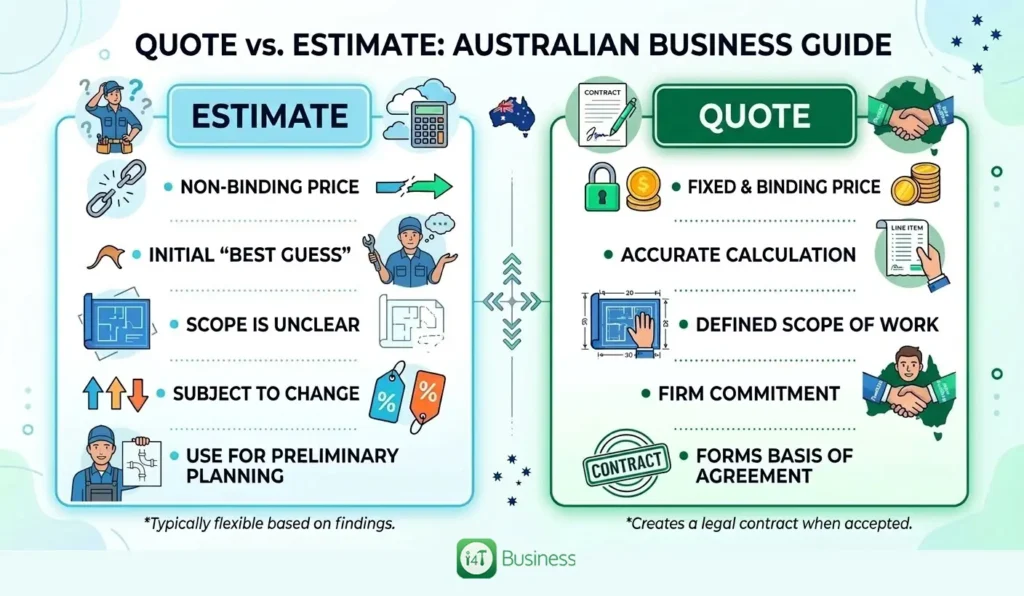
An estimate is usually a best guess based on limited information. You might use one when you haven’t fully inspected the site, when conditions are unknown (like what’s behind a wall), or when the scope can’t be confirmed until you start.
A quote, on the other hand, is typically a more fixed price for a defined scope of work. If the scope is clear and the customer accepts the quote, it can form the basis of an agreement. That’s why it needs to be written clearly and include the right details.
Knowing the difference between estimates and quotes is useful for keeping expectations clear.
Where automated quoting helps is that it standardises your wording. You avoid sending mixed messages like calling something a quote when it’s really an estimate, or leaving out details that protect you if the job changes.
What should a good quote include for trade work?
A good quote is not just a number. It’s a simple, written explanation of what you’ll do, what the customer gets, and what it will cost, without confusion. The clearer your quote is, the easier it is for a customer to say yes. Make sure your quote is complete and easy to understand.
A solid tradie quote usually covers the basics like scope, pricing, timing, and payment terms, but the real magic is in the details that prevent misunderstandings. Customers want to feel like the quote “matches” what they asked for. When it does, they trust it.
Using job estimation software in Australia helps because you can build strong templates that already include the essential sections. You can still adjust the quote for each job, but you’re not reinventing structure every time, and you’re far less likely to forget something important.
How does faster quoting help you win more jobs?
Speed matters because customers don’t pause their decision-making while you catch up on admin. In most cases, they reach out to multiple tradies and then compare whoever gets back to them first with something that looks clear and professional.
A fast quote doesn’t mean a sloppy quote. It means you can respond while the job is still fresh in your head, the customer is still engaged, and you still have momentum. When the quote arrives quickly, customers feel like they’re being looked after, and that “good service” impression starts before the work begins.
With an automated quoting system, speed becomes realistic because you’re not writing everything manually. You’re selecting a job type template, adjusting quantities or labour hours, adding a few notes, and sending it straight away. That’s how you turn “I’ll send it tonight” into “you’ll have it in 15 minutes.”
How does automated quoting reduce mistakes that cost you money?
Most under-quoting happens quietly. It’s rarely one big obvious mistake; it’s usually small missed items that stack up and chew through profit.
Think about the stuff that’s easy to forget when you’re quoting quickly:
- travel time between jobs
- call-out fees
- disposal or dump fees
- consumables
- admin time
- loading for tricky access, tight roofs, long cable runs, or unknown conditions
When you’re doing quotes manually, it’s easy to forget one or two of these and not even realise until you’re halfway through the job and your margin is already gone.
Trade quoting software helps because it prompts consistency. Templates and standard line items act like a safety net. They don’t stop you from adjusting the quote; they stop you from forgetting the basics.
How does it make your business look more professional?
Customers might not understand the technical side of your work, but they do understand confidence and clarity. Your quote is often the first proper “document” they see from your business, and it creates an impression straight away.
A messy quote can accidentally make you look disorganised, even if you’re excellent on the tools. A clear quote does the opposite. It tells the customer:
- you’ve listened
- you know what the job involves
- you’ve allowed for the right details
- you’ve set expectations properly
Professional quoting also reduces customer hesitation. When the quote is easy to read and feels complete, customers don’t need to ring you back with ten questions just to feel comfortable. That alone helps move them toward approval faster.
How does automated quoting help avoid pricing confusion and disputes?
Pricing disputes usually come from unclear scope, not bad customers. If the customer reads your quote and interprets it differently than you intended, you can end up with pushback, delays, or awkward conversations on-site.
Automation helps because it encourages structure: inclusions and exclusions, assumptions, and clear breakdowns. Even when you keep it simple, a consistent format makes misunderstanding less likely.
It also helps you show pricing clearly. Businesses must display the total price clearly, including taxes and any unavoidable fees. While that guidance is often discussed in advertising, it’s also a useful standard to apply in quoting, so customers aren’t surprised by add-ons later.
When customers feel like the quote is transparent, they trust it more, and trust is a big part of winning work.
How does automated quoting help with variations and extra work?
Variations are normal in trade work. Sometimes the job changes because the customer changes their mind. Sometimes it changes because you uncover something you couldn’t see at the quoting stage.
The problem is when extra work happens without clear communication. That’s where misunderstandings start: the customer assumes it’s included, you assume it’s obviously extra, and suddenly you’re negotiating while standing in someone’s driveway.
With an automated quoting system, variations become simple and professional. You update the scope, add the extra line item, and resend for approval.
This protects your margin and keeps the relationship clean.
Does automated quoting help with follow-up and stopping quote ghosting?
Quote ghosting is frustrating, but it’s also common. Most customers aren’t trying to be rude. They get busy, they’re comparing options, or they’re waiting on a partner to decide. Some just forget.
The big problem is that follow-up often relies on your memory, and when you’re flat out, that’s not reliable. Automated quoting helps by making follow-up part of the process. You can set reminders, see which quotes are still pending, and follow up at the right time.
It also makes follow-up less awkward, because you’re not “chasing”, you’re simply checking in at the right moment with a simple message like: “Just making sure you got the quote, happy to answer any questions.”
That kind of consistent follow-up can be the difference between “no reply” and a booked job.
What should you look for in quoting software for tradies?
The best quoting tools for tradies don’t feel like office software. They feel like a practical extension of your day-to-day work, quick to use, easy to adjust, and built around how jobs actually run.
Look for something that helps you quote accurately and move smoothly into doing the job. Ideally, it should reduce double-handling so you’re not retyping the same information three times.
A useful shortlist is:
- templates for common jobs
- saved rates and standard line items
- easy mobile quoting on-site
- clear totals with GST support
- quick customer approval
- quote-to-job workflow (so you can schedule once approved)
When those pieces are in place, your quoting process becomes a system, and systems win more jobs than “I’ll get to it later.”
Automated quoting helps you win because it improves the whole buying experience
Customers don’t only choose the cheapest tradie. They choose the tradie who makes the process easy and feels trustworthy. Automated quoting helps you do that by improving the parts customers care about most: fast response, clear scope, confident pricing, and professional presentation.
And it helps you too. You save time, reduce costly mistakes, protect your margins, and spend less mental energy chasing quotes.
If you want to tighten up quoting and win more work without adding more admin, i4T Business field service management software helps you manage job quoting from end to end, from building quotes quickly to getting approvals and converting accepted quotes into scheduled jobs.
Book a demo today!
FAQs
For most tradies, you can get the basics set up in a few hours by building templates for your most common job types. Start with the work you quote every week, like call-outs, standard installs, or maintenance jobs. After that, it’s just small tweaks as you notice better wording, pricing, or inclusions you want to standardise.
Usually not. Most systems send the quote by email or SMS with a simple link the customer can open on any phone. They can review the details, ask a question if needed, and approve without downloading anything. That convenience matters because it removes friction and makes it easier for customers to say yes quickly.
Yes, that’s one of the biggest practical benefits. You can build a quote while the job is fresh in your mind, add notes or photos straight away, and send it before you leave. It also helps you avoid going home, forgetting details, and having to call the customer back to clarify what was discussed.
If your system has a price list, you update it once and then future quotes can pull through the new rates automatically. This is handy when suppliers increase prices, or you decide to lift your labour rate. It also helps keep your team aligned, so everyone is quoting from the same current pricing instead of old numbers.
Yes, often even more so, because you’re doing the quoting, chasing, scheduling, and jobs yourself. Automation reduces the after-hours admin load and helps you stay consistent when you’re flat out. It also makes your business look bigger and more organised, which can help win higher-value work.
Hot off the press!