

The phones don’t stop, the air-con’s working overtime, every second customer wants it done “before Christmas, mate”… and half your team is trying to lock in annual leave.
Welcome to the silly season.
For most tradies and field service businesses, November through January is a wild mix of packed calendars, urgent call-outs, staff holidays and the odd no-show, all while you’re trying to keep customers happy and your team from burning out. It’s no wonder the words “Christmas roster” can make even experienced business owners cringe.
The upside? With some smart planning, clearer rules and better communication, field service scheduling during holidays can go from chaotic to controlled. You can protect your team’s wellbeing, keep customers onside and still make the most of that busy-season revenue.
This article walks through how to schedule technicians over Christmas, how to manage staff leave and jobs in the busy season, and how to build a repeatable game plan you can use every year.
Why the Holiday Season Feels So Messy
The silly season is tricky because three big forces hit your business at the same time.
First, demand spikes. People want everything sorted “before visitors arrive”, “before we shut down” or “before Christmas lunch”. Systems that have limped along all year finally give up in the heat. Storms, surges and overuse all take their toll. Bookings pile up, and the phone doesn’t stop.
Second, your capacity drops. Your team quite reasonably wants time off. Some travel, some want to spend time with family, and some just need a break. You’re working with fewer people on the tools and in the office, right when demand is at its peak.
Third, emergencies increase. There’s more pressure on infrastructure, more parties, more usage, more everything. That means more breakdowns, more urgent call-outs and more “we need you now”.
When you mix those three factors together without a plan, you get exhausted technicians, overpromising, annoyed customers and a business owner who doesn’t really get a holiday at all. The aim of good field service scheduling during holidays is to accept that this surge is coming and design your operations around it, rather than just reacting.
Look Back Before You Lock Anything In
Before you start approving leave, booking big jobs or promising dates, take a breath and look backwards. Your own history is the best data you have.
Think about the last couple of holiday seasons. Even if your records are a bit rough, you can usually spot patterns quite quickly. Which weeks felt insane? Which days were full of breakdowns? Was there a particular trade or service you got more calls about? Did things slow down a lot in early January, or was that surprisingly busy too?
If you have records handy, old schedules, invoices, or calendar entries, scan through them. You’re looking for rough answers to questions like:
- Which weeks were consistently the busiest?
- What type of work spiked: installs, maintenance, breakdowns, emergencies?
- Were there “dead days” where almost everyone was off, and you struggled to respond?
Once you’ve done this, mentally sort your typical holiday work into three broad categories:
- Work that must be completed before Christmas or the New Year.
- Work that can safely roll into January without causing major issues.
- Work that is genuinely unpredictable, like emergency breakdowns and storm damage.
You might be surprised how much fits into the second bucket when you talk honestly with customers. This kind of sorting is a simple but powerful way to make field service scheduling during holidays more realistic. It helps you see what truly needs to be squeezed into the calendar and what can be gently shifted into quieter weeks.
Managing Staff Leave Without Dropping the Ball
Your team is your biggest asset, and the silly season is when they’re under the most pressure. If you try to block all leave, morale and loyalty take a hit. If you say yes to everyone, you won’t be able to deliver. The sweet spot is somewhere in the middle, with clear rules and transparent decision-making.
Start by setting expectations early. Don’t wait until December to talk about Christmas. Let your team know, well in advance, how you’ll be handling leave in the busy period. Share your likely closed days, reduced-hours days and full-capacity days. This shows you’re thinking ahead and gives everyone a fair chance to plan their family time.
Next, establish some simple guidelines around leave approvals. For example, you might:
- Set a deadline for submitting holiday leave requests.
- Limit how many people from the same role or crew can be off on the same day.
- Decide which dates are “critical coverage” days that need a minimum number of techs and office staff.
The key is consistency. Even if people don’t get exactly the dates they wanted, most will accept it if the process is clear and fair.
It also helps to think about how you’ll handle the “unpopular” days. Public holidays, Christmas Eve, Boxing Day and New Year’s Eve can be rotated year to year, so the same tech isn’t stuck with them every time. You might also offer a small sweetener, a day in lieu, a bonus, or first pick of other dates to those who cover those shifts.
When you manage staff leave and jobs in busy season with transparency and a bit of compassion, you’ll find your team is much more willing to step up when you really need them.
How to Schedule Technicians Over Christmas
This is where the rubber meets the road: how to schedule technicians over Christmas so they can do a solid job, stay safe and still get some rest.
One of the biggest pitfalls is treating every job like it’s equally urgent and equally important. It isn’t. A total power loss in a family home during a heatwave is not the same as a non-critical upgrade or a minor cosmetic fix. The silly season is the time to be very deliberate about what gets your prime time.
A simple approach is to prioritise jobs into three levels:
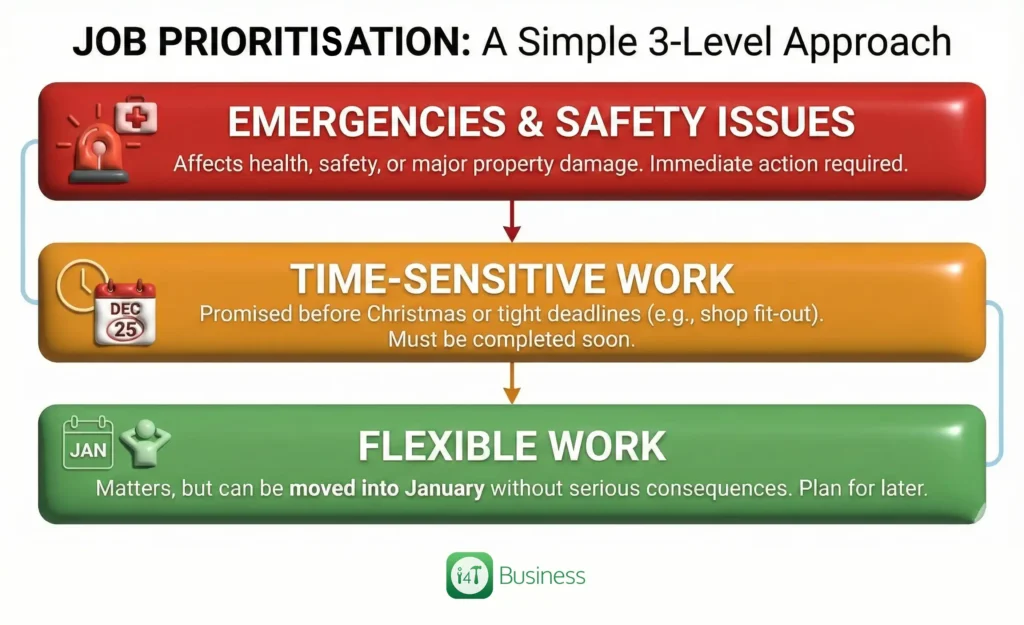
- Emergencies and safety issues – anything that affects health, safety or major property damage.
- Time-sensitive work – jobs you’ve already promised for before Christmas or jobs tied to tight deadlines (like a shop fit-out before opening day).
- Flexible work – jobs that matter, but can be moved into January without serious consequences.
Once you’re clear on that, you can start building a schedule that actually reflects reality. For emergencies and time-sensitive work, you protect those time slots carefully. For flexible work, you offer January dates with clear explanations: “We’re prioritising urgent and safety-related jobs in December, but we can lock you in early in the new year.”
Matching technicians to jobs also becomes more important. Instead of simply slotting in whoever looks free, think about:
- Who has the right skills to fix it properly the first time?
- Who is already working in that area, so driving time is minimised.
- Who has enough capacity that day to handle an emergency if it pops up?
Another powerful tool is buffer time. During the holiday period, jobs tend to take longer than expected. Traffic, parking, customers wanting a chat, extra “while you’re here” requests, they all add up. Booking your day at 100% capacity is asking for a blowout. Leaving some space between jobs lets you absorb delays without blowing up the rest of the schedule.
Many field service businesses also find it helpful to mentally split the team into two loose groups during the busiest weeks: one focused on pre-booked, planned work and another kept more flexible for same-day or urgent work. The exact mix will depend on your trade and demand, but the idea is to stop every new job from rearranging the whole calendar.
Done well, this approach to how to schedule technicians over Christmas reduces stress, improves punctuality and helps your techs feel like the work is achievable, not impossible.
Emergencies and After-Hours
No matter how carefully you plan, the silly season comes with a certain number of “everything’s broken, and we need you now” calls. The goal isn’t to eliminate those; you can’t, but to handle them in a controlled way that doesn’t derail everything else.
The first step is agreeing on what actually counts as an emergency. This will vary by trade, but typically includes things like major water leaks, total loss of power, gas leaks, dangerous faults, refrigeration failures for commercial clients, or no cooling in extreme heat for vulnerable people. Write this down and share it with your team so everyone is on the same page.
Once you’ve defined it, design a basic after-hours and public-holiday system around it. That might include:
- A rotating on-call roster so responsibility is shared fairly.
- Clear time windows for response
- A simple process for logging and allocating those jobs quickly.
The person who answers the phone, whether that’s someone in your office, you as the owner, or an answering service, needs a short set of triage questions. These might cover things like:
- Is anyone in immediate danger?
- Is the whole system down, or just part of it?
- Have you turned off the power or water at the main if it’s unsafe?
- Is this affecting essential services or just convenience?
The answers give you enough information to decide whether it’s a “drop everything now” job, a same-day response, or something that can be booked into the next standard slot. Customers usually appreciate your honesty if you explain why you’re prioritising certain calls.
This structure helps you respond to genuine emergencies without treating every noisy fan or flickering light like a full-blown crisis. It’s a big part of making field service scheduling during holidays manageable instead of mayhem.
Use Communication To Calm Everyone Down
The way you communicate with customers can make or break your holiday season. Most people don’t mind waiting a bit longer if they understand what’s going on. What they hate is feeling ignored, forgotten or misled.
A good starting point is to make your holiday operating hours crystal clear and to do it early. Put them on your website, share them on social media, update your Google listing, and send a simple email or SMS to your regular clients. Let people know:
- Which days are you closed completely?
- Which days are you running normal hours?
- Which days are “emergencies only”?
- Roughly how long can they expect to wait for non-urgent work?
Then, back that up with good communication around individual jobs. When you book someone in, confirm the date and time and give them any prep they might need to do. On the day, aim to let them know if the tech is running late or if something unexpected has come up.
Being upfront about your priorities also helps. If you’re pushing non-critical work into January so you can focus on emergencies and safety-related jobs in December, say so. Many customers will be happy to wait if they respect the reason.
Good communication doesn’t magically create more hours in the day, but it does reduce stress, follow-up calls and complaints. That frees up your team to actually get the work done rather than constantly firefighting expectations.
Using Systems and Tools to Orchestrate the Chaos
Even with the best intentions, trying to run all of this on a whiteboard, in a diary or across a pile of text messages is risky. Things get missed, double-booked or forgotten. Rescheduling becomes a headache. Nobody has a clear picture of what’s happening.
This is where a solid job management system earns its keep. When all your jobs, schedules, notes, priorities, locations and staff availability live in one place, managing staff leave and jobs in busy season gets much easier. You can see, at a glance, who is working where, which jobs are booked, which ones are waiting, and where there’s room for emergencies.
It also makes it far simpler to adjust on the fly. A tech calls in sick? You can see which team members are nearby and reallocate their jobs. An urgent call comes in? You can quickly spot the closest available tech with the right skills. A customer cancels? You can slot someone else into that gap rather than leaving dead time in the schedule.
On top of that, a good system gives you a record of what actually happened. When January rolls around, and you’re planning for next year, you’ll have real data on job volumes, busy days, response times and technician utilisation. That’s gold when you’re trying to refine your holiday strategy.
Turning This Year’s Experience into Next Year’s Advantage
Once the rush is over and you’ve had a chance to breathe, take some time to review how it all went. It doesn’t have to be a massive project; even an afternoon with a notebook and your team can uncover useful insights.
Ask yourself and your staff:
- Which days felt completely overloaded, and why?
- Were there days when extra leave could have been allowed without causing issues?
- Did your emergency definition work, or did too many jobs end up being treated as urgent?
- Where did communication with customers fall?
- Did your scheduling patterns make sense, or were techs criss-crossing the city?
If you have access to reports and job data, use them to back up those impressions. You might notice that Wednesdays were consistently overloaded, or that response times dipped on certain dates, or that some types of jobs always take longer than you assumed.
Use those lessons to tweak your approach for next year. That might mean adjusting your leave rules, tightening up what counts as an emergency, shifting certain types of work into January, or changing how you group jobs geographically. Each year you do this, field service scheduling during holidays becomes a little more predictable and a lot less stressful.
Wrapping It All Up
The silly season will probably always be busy. Things will still break at the worst possible time. Customers will still want miracles. The aim isn’t to make the holidays quiet; it’s to make them manageable.
By looking back at your past seasons, planning leave with clear rules, being thoughtful about how to schedule technicians over Christmas, putting structure around emergencies, and communicating honestly with customers, you can protect both your team and your reputation. Add in some solid systems, and suddenly you’re not just surviving the holidays, you’re using them as a chance to grow, impress and learn.
If you’d like your next holiday season to be more organised, less frantic and a lot easier to control, it might be time to upgrade the way you handle jobs and scheduling. A dedicated job management platform like i4T Business can bring everything, jobs, schedules, staff leave, priorities and customer updates, into one place, so you’re not juggling five different tools while the phones are going crazy.
Set things up now, and when the next Christmas rush rolls around, you’ll be ready.
FAQs
It’s best to start eight to ten weeks before Christmas. That gives you time to review past years, set leave rules, share your holiday hours and book key jobs with realistic dates.
Use a system everyone understands. Rotate the big dates each year and consider offering small incentives to those who work public holidays or take on-call shifts. Fairness and clarity go a long way.
Define clearly what counts as an emergency and use a few triage questions when calls come in. True emergencies get priority; less critical issues are booked into the next available normal slot with an honest explanation.
Prioritise jobs, leave buffer time in the schedule, group work by area and avoid booking every minute of the day. Make sure techs get proper breaks and don’t carry all the after-hours load themselves.
Have a clear process for reshuffling. Look at who is nearby, which jobs can be moved, and which must go ahead. Good systems help you reassign work quickly and keep customers updated.
It depends on your trade and customer base. Some businesses close completely, others run a skeleton crew or an on-call service for emergencies only. Whatever you decide, be upfront and consistent so customers know what to expect.
Hot off the press!

With our cutting-edge technology and in-depth knowledge of how the Field Service Management sector operates, the i4TGlobal Team loves to share industry insights to help streamline your business processes and generate new leads. We are driven by innovation and are passionate about delivering solutions that are transparent, compliant, efficient and safe for all stakeholders and across all touch points