

TL;DR
Inventory problems kill tradie profit through stock-outs, phantom stock, missing tools, wasted materials, and outdated pricing that blows out quotes.
Here’s how to fix it fast:
- Track stock by location and log every move
- Set reorder points for fast movers
- Do quick cycle counts regularly
- Run a basic tool management system with assigned tools and check-in/out
- Quote using current availability and pricing, i4T Business helps connect this, so margins stay protected
If you’ve ever turned up to a job and realised the part you swore was in the van has vanished, you already know how inventory issues quietly destroy profit. It’s rarely one huge mistake. It’s the constant drip-feed of small losses, extra trips to the supplier, jobs running late, technicians improvising, and quotes that don’t match today’s pricing.
Inventory is also messier for tradies than most businesses. Your stock doesn’t live in one neat room. It’s spread across the warehouse, the shed, multiple vehicles, job sites, and sometimes sitting on backorder with suppliers. That’s why a “basic list” often falls apart once you start growing.
The good news is you don’t need a complicated corporate setup to fix it. You need a few simple habits that match how trade businesses actually work, and (when you’re ready) inventory tracking software for trades that makes those habits easy to follow. A proper inventory approach helps you keep accurate records, set reorder points, and stay on top of stock levels and costs.
Below are the inventory management problems that kill margin, plus the fixes that actually stick.
What are the biggest inventory management problems that kill profit for tradies?
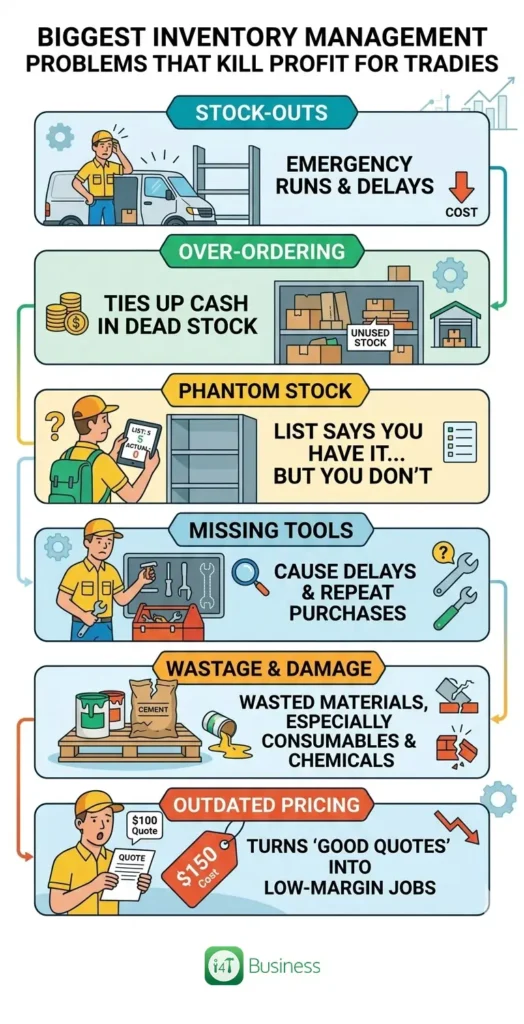
Most profit loss doesn’t come from one massive stuff-up. It’s death by a thousand cuts. The big ones usually look like:
- Stock-outs that create emergency runs and delays
- Over-ordering that ties up cash in dead stock
- Phantom stock (your list says you’ve got it… but you don’t)
- Missing tools that cause delays and repeat purchases
- Wastage and damage, especially with consumables and chemicals
- Outdated pricing that turns “good quotes” into low-margin jobs
If any of those happen regularly, you’ll feel it in your calendar, your cash flow, and your stress levels. This is where “Inventory management software issues and fixes” becomes a real thing, because the problem is rarely just the software. It’s the system around it.
Why do tradies end up with phantom stock (and how do you stop it)?
Phantom stock is what happens when stock moves faster than your record-keeping. In a trade business, that’s basically every day. Parts move from warehouse to van, van to job site, job site back to the shed, and sometimes to another vehicle because someone’s short on a fitting. If those movements don’t get logged, your “stock list” becomes a suggestion rather than the truth.
The fix is to stop thinking of inventory as one pile of parts and start thinking in locations. When you treat the warehouse, each van, and each job site as separate locations, it becomes easier to keep things accurate.
To make this work in the real world, you only need one rule: if stock moves, it gets recorded. That can be done manually at first, but it becomes far easier when you use inventory tracking software for trades that’s built for quick field updates and location-based stock.
How do stock-outs cost money beyond being annoying?
Stock-outs don’t just cost you the missing part. They cost you momentum. A job that should’ve been smooth turns into a delay, a reschedule, an awkward customer conversation, and a run sheet that no longer makes sense. Your team loses billable time, your admin time increases, and the risk of shortcuts rises because everyone’s trying to “just get it done.”
The fix is simple and effective: reorder points. A good inventory process includes monitoring stock levels and setting reorder points so you’re replenishing before you hit zero. That’s one of the key ways businesses avoid constant stock emergencies.
Start with your highest-use items. Once your fast movers are controlled, your day-to-day chaos quickly reduces.
How do you stop over-ordering and dead stock without running out?
Over-ordering usually comes from fear. No one wants to be caught short, so you buy extra. But over time, that “extra” becomes dead stock – cash sitting on shelves that could’ve been used for wages, marketing, new tools, or simply keeping your buffer healthy.
The fix isn’t to stop stocking. It’s to stock with intention.
Your fast movers should have minimum and maximum levels, so you top up without overloading. Job-specific items should be purchased for that job (not “just in case”). Rarely used items should be kept lean and reviewed regularly so they don’t slowly multiply.
If you do regular stock checks and keep records accurate, you can hold less stock without risking stock-outs, which improves cash flow and reduces waste.
What’s the best way to track inventory across warehouses, vans, and job sites?
The moment you have more than one vehicle or technician using stock, spreadsheets and “mental tracking” starts to collapse. Not because spreadsheets are bad, but because they rely on perfect behaviour. One missed update, and the whole system becomes unreliable.
The best approach is to have one source of truth that tracks stock by location and makes it easy to record usage as part of the job. In practice, that means your item list is consistent, your locations are defined, and transfers are recorded when stock moves between them.
This is where inventory tracking software for trades becomes genuinely useful, because it’s built for multi-location tracking and mobile use, which is exactly how trade inventory behaves.
How do you set up a tool management system so gear stops going missing?
Tools are profit-makers and profit-leakers. A missing tool doesn’t just cost money to replace. It wastes time, delays jobs, and pushes people to improvise.
A basic tool management system doesn’t need to be complicated. It needs to be consistent.
Start with a simple register that includes:
- Tool name and type
- Serial number (if it has one)
- Assigned person or vehicle
- Last known location
- Condition and service schedule
Then add one habit: check-in/check-out, even if it’s just a quick scan and tap on the phone. When tools have a home and an owner, they go missing less. Simple.
How often should you do a stocktake, and what’s the quickest way that works?
Stocktakes have a bad reputation because people try to do them as a massive, exhausting event. But stocktakes are valuable because they bring your records back to reality. They help you confirm what you actually have and help calculate the value of trading stock, which matters around the end of the financial year.
The quickest way to do this without losing a whole weekend is to use smaller cycle counts. Instead of counting everything at once, you count a section regularly. That keeps your inventory accurate all year, which means EOFY isn’t a panic.
How do pricing changes wreck quotes, and how do you protect your margin?
Pricing changes hit tradies, especially small businesses, in the worst way because quotes are usually agreed upfront, but supplier prices can move quietly in the background. When you quote off an old cost, you don’t notice the damage until you’re ordering materials and your margin has already vanished.
The fix is to keep your pricing source current and connected to quoting so you can make informed decisions. That means regularly updating your common items and building your quoting process around current costs and availability rather than assumptions.
When you track and manage what’s available through your warehouse and what it currently costs, quoting becomes more accurate and far less stressful.
What inventory storage mistakes create waste, damage, and compliance headaches?
Not all inventory is harmless. Many tradies store chemicals, solvents, adhesives, and other hazardous products. If these are stored poorly, you can lose stock through damage and also create safety risks.
Safe Work Australia provides guidance on storing hazardous chemicals, including ensuring chemicals are stored correctly with appropriate identification, such as signs and labels, and managing storage safely.
Even if you’re not dealing with extreme hazards, simple improvements like clear labelling, safe storage zones, and regular checks reduce waste and reduce the chance of a workplace safety issue.
What are the most common inventory management software issues and fixes?
This is the part most businesses get wrong. They buy software, load it with messy data, and then wonder why no one uses it. The truth is that most Inventory management software issues and fixes come down to setup and habits.
Common problems include inconsistent item naming, duplicate items, missing units, and processes that are too slow for the field.
Fixes that work:
- Start with your top 30–50 items
- Create naming rules (one item name, one unit, one code)
- Build inventory updates into the job workflow (used, returned, transferred)
- Use a system that supports simple tracking, reorder points, and stocktake habits
The best fix is to start small and build consistency. Inventory systems work best when they support the basic principles of stock control, including maintaining accurate records and regular checking.
Stop guessing and start quoting with confidence
Inventory problems kill profit when you’re forced to guess. Guessing whether you have the stock, guessing where it is, guessing whether prices have changed, and guessing whether you can finish the job without delays.
The fix is a simple system that fits trade reality: track stock by location, keep records accurate, set reorder points on fast movers, and do regular checks so your numbers match what’s actually in your warehouse and vehicles.
If you want to tighten this up even further, i4T Business field service management software helps you quote customers accurately with access to material availability and pricing from the warehouses. That means fewer surprises mid-job, better margin control, and a smoother workflow from quote to completion.
FAQs
Phantom stock is when your list or spreadsheet says you’ve got parts available, but they’re missing in real life. It usually happens when stock is moved between the warehouse, vans, and job sites without being recorded.
Stock-outs don’t just slow a job down; they create extra supplier runs, lost billable time, and rescheduling headaches. They can also lead to rushed substitutions, which increases the chance of call-backs and unhappy customers.
Start with your top 20–50 fast-moving items and track them properly. Set simple reorder points so you restock before you run out, instead of relying on memory or last-minute panic orders.
Because tools are mobile and easy to lose across vehicles and job sites. A basic tool management system helps you assign tools to a person or vehicle, track where they were last seen, and reduce repeat purchases and job delays.
Make sure your quotes are based on current material costs and real availability, not old price lists or guessing. Using i4T Business can help by connecting quoting to warehouse stock and pricing, so your margins are less likely to get smashed mid-job.
Hot off the press!