

TL;DR
Keeping good staff in a trades business comes down to four basics:
- Pay people fairly and clearly,
- Give them a visible growth path,
- Offer practical benefits that make work easier, and
- Run fair rosters that reduce burnout.
Add simple onboarding for apprentices, regular quick feedback, and better job systems to cut daily frustration and rework. The more organised and respectful the workplace feels, the more likely good apprentices and technicians are to stay.
Keeping good people is one of the biggest “make or break” challenges for Aussie trade businesses right now. When a solid apprentice or a gun technician walks, you don’t just lose a set of hands. You lose job knowledge, customer relationships, and momentum. Then you’re stuck recruiting, retraining, and absorbing the chaos that comes with it.
This guide is built for busy tradies who want staff retention ideas for tradies in Australia that actually work on real job sites. It’s also aimed at the question most owners ask when they’ve finally found a great team member: how to keep good apprentices and technicians for the long run.
What does “good retention” look like in a trades business?
Retention isn’t just people staying forever. It’s people staying long enough to get great at the way you run jobs, care about your standards, and build trust with your customers. In a trade business, “good retention” usually looks like fewer surprise resignations, less constant re-training, and a team that runs jobs smoothly without drama.
A simple way to spot healthy retention is to watch your weekly rhythm. Do jobs finish with fewer call-backs? Are apprentices progressing steadily instead of stalling? Are you spending more time quoting and improving the business, and less time plugging gaps in the roster? If the answer is yes, you’re doing something right.
How do I pay fairly and stay compliant without guessing?
Pay is one of those topics where uncertainty causes friction fast. People can handle “not perfect” pay better than they can handle “unclear” pay. The biggest retention win here is confidence: your team should know you’re paying correctly, consistently, and on time.
In Australia, minimum pay and conditions often depend on the relevant award, classification, penalties, overtime, and allowances. Apprenticeship pay depends on factors like their training stage and the details of their apprenticeship arrangement. Fair Work is the safest place to double-check the basics, especially for apprentice and trainee pay rates and how they’re applied.
A practical approach is to make pay reviews predictable. Even if you can’t always lift wages dramatically, you can commit to a clear review cycle and transparent criteria. That alone builds trust because people feel seen instead of taken for granted.
What benefits actually help keep good people beyond base pay?
Benefits work best when they remove real-life annoyances for tradies. If a benefit is hard to access, confusing, or feels like a gimmick, it won’t land. If it makes a tech’s week easier, it’s gold.
A few benefits that tend to matter in trades businesses are:
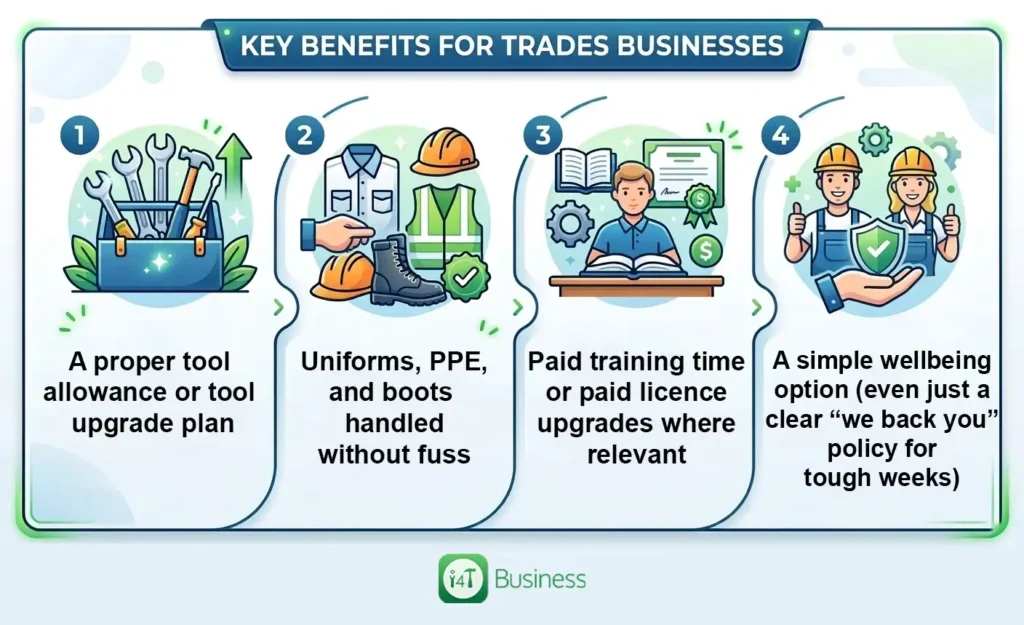
- A proper tool allowance or tool upgrade plan
- Uniforms, PPE, and boots handled without fuss
- Paid training time or paid licence upgrades where relevant
- A simple wellbeing option (even just a clear “we back you” policy for tough weeks)
The trick is to keep it fair and consistent. If one person gets a perk quietly and others don’t understand why, it can backfire. Set the rules, communicate them clearly, and apply them the same way every time.
How do I create a growth path so technicians don’t leave for “the next step”?
People leave when they feel stuck. That’s true for apprentices who want to see a future, and it’s true for qualified techs who want more responsibility or variety. A growth path doesn’t need to be fancy. It just needs to be visible.
Spell out what “leveling up” looks like in your business. For example, an apprentice might move from basic support tasks to running parts of a job, then to leading simple jobs with supervision, and eventually to fully independent work. For qualified staff, growth might mean becoming the go-to specialist, a team lead, a supervisor, or moving into estimating, scheduling, or customer-facing work.
A big retention lever is linking progression to skills and behaviours, not just time served. When people know exactly what to do to earn the next step, they’re more likely to stay and push forward.
What’s the best way to keep apprentices motivated in the first 3 to 6 months?
Early-stage apprentices often quit because of the day-to-day experience, not the trade itself. If they feel ignored, constantly in trouble, or stuck doing nothing meaningful, they’ll drift. The first few months need structure and support, even if it’s lightweight.
The best approach is to be intentional with onboarding. Give them a simple run sheet for their first weeks: what “good” looks like, how your jobs are run, what tools they’ll use, and who they can ask for help. A buddy system works well, too, as long as the buddy is genuinely patient and not a blow-up merchant.
Also, keep feedback frequent and small. Apprentices improve faster when they get quick course-corrections instead of a big “performance chat” after they’ve been doing something wrong for weeks.
How can I roster fairly and reduce burnout at the same time?
Rosters are retention in disguise. People might say they left for more money, but often they really left for a life that felt manageable. If the roster feels chaotic, unfair, or constantly changing last minute, even your best workers will start looking around.
A fair roster is one that feels predictable and balanced over time. That might mean rotating on-call duties properly, giving enough notice for weekend work, and avoiding a culture where the same reliable person always gets asked to “just squeeze one more in”.
If you want a simple rule, aim for consistency. When people can plan their week, they cope better. When they can’t, every small issue feels bigger, and resignation starts sounding like relief.
How do I remove the daily frustrations that make good staff crack?
This is the sneaky one. Good staff don’t only quit for pay. They quit the grind of preventable mess: missing job info, unclear scope, constant rework, and getting blamed for problems they didn’t create.
Think about the friction points that waste time:
- Driving to the site with the wrong parts because the job notes were vague
- Repeating the same customer conversation because history wasn’t recorded
- Returning to fix something because the original job wasn’t documented properly
- Arguments between office and field because expectations weren’t clear
When you tighten up those basics, you make work feel professional. And when work feels professional, people feel proud to be part of it.
What feedback style works best for technicians and apprentices?
Tradies usually don’t want long, corporate feedback sessions. They want direct, respectful communication, and they want it close to the moment. The best feedback is clear, specific, and focused on the job standard, not the person’s identity.
A simple pattern is: what went well, what needs to change, and what “good” looks like next time. Keep it calm, keep it practical, then move on. That approach builds confidence without creating resentment.
One extra retention tool that’s underrated is a quick “stay chat” every so often. Nothing formal. Just asking: what’s going well, what’s annoying you, and what would make you more likely to stay the next year. When people feel heard early, they’re less likely to resign suddenly later.
How do I deal with underperformance without losing my best people?
Ignoring underperformance is a fast way to lose your strongest staff. They watch what you tolerate. If someone constantly shows up late, does sloppy work, or creates headaches, and nothing happens, your best workers start thinking you don’t care about standards.
The key is consistency and fairness. Be clear about expectations, coach early, and document patterns. Most issues improve when the person understands the standard and gets support to reach it. But if they won’t improve, your good staff need to see that the standard matters.
Handled well, this actually boosts retention. Your best people stay when they know the workplace is fair and professional, not chaotic and political.
What systems make people stay because the business feels organised?
A well-run business is easier to work in. It sounds obvious, but it’s powerful. When jobs are scoped properly, notes are clear, photos are recorded, and customers are kept in the loop, your team gets fewer surprises and fewer angry calls. That reduces stress and improves morale.
This is also where reputation matters. When customers are happier, they treat your staff better. That flows straight into retention because nobody wants to cop abuse on-site due to preventable misunderstandings.
And zooming out, the broader labour market still matters. Jobs and Skills Australia has highlighted elevated skills shortages in recent years, which is a reminder that keeping great staff is often easier than finding replacements.
Keep it fair, keep it clear, keep it human
If you want a simple retention formula, it’s this: pay clarity, real growth, benefits that remove friction, and rosters that feel fair. Add consistent feedback and a more organised job flow, and you’ll be miles ahead of the average trade business.
You don’t need to overhaul everything at once. Pick one area to improve this month, make it obvious to the team, and stick to it. Small consistency beats big promises every time.
If you want retention to improve without adding admin chaos, i4T Business can help by giving your tradie employees an easier way to run jobs day-to-day. When your team can capture job details accurately, record notes and photos properly, and keep customer communication cleaner, you get better service efficiency, fewer mistakes, stronger job records, and happier customers. That reduces daily frustration for staff, lifts professionalism, and helps good people feel like they’re part of a business that’s got its act together.
FAQs
Clear pay, fair rosters, practical benefits, regular feedback, and a real growth path are the biggest retention drivers.
Give them structure early, train them properly, recognise good work, and show exactly how they can progress in your business.
Pay matters, but many leave because of burnout, poor rostering, messy job processes, or feeling undervalued.
Simple, useful benefits like tool support, uniforms/PPE handled properly, paid training time, and predictable time off.
A clear cycle helps, like a check-in every 6 months and a proper pay/performance review every 12 months, depending on your workload and budget.
Hot off the press!