

Many Australian trade businesses stay busy and booked out, generating steady revenue but struggle to keep enough profit. One common reason is hidden small business costs quietly chipping away at margins on every job.
Hidden costs in a trade business are expenses that are not properly tracked, priced into jobs, or recovered from customers. These can include travel time, fuel, admin, rework, warranty calls, equipment wear, material waste, late payments, underquoted labour, insurance, compliance, and downtime.
1. Why Busy Trade Businesses Still Struggle With Profit
It’s easy to confuse revenue with profit, especially when your trade business is booked solid. Revenue is the total money you bring in from jobs, but that’s only the starting point. Cash flow shows the money moving in and out of your accounts, crucial for day-to-day survival. Gross profit means revenue minus direct job costs like materials and labour, while net profit subtracts all overheads and hidden expenses.
For example, a plumbing job might appear profitable when the invoice hits your account. But once you add unpaid labour spent on travel or admin, fuel costs, rework, and the share of overheads like rent and insurance, the margin shrinks. Many tradies don’t account for these properly, leading to a surprise when their bank balance doesn’t reflect the busy schedule.
2. The Hidden Small Business Costs That Hurt Trade Businesses Most
Understanding these hidden costs is your first step to protecting profit. Let’s look at the biggest profit killers and how to tackle them.
Unbilled Labour Time: You might spend extra time on jobs — travelling, prepping, or wrapping up — that isn’t billed. This unpaid labour eats into your profit and is often overlooked because it’s harder to track than hours worked on site. Start by logging all time related to jobs and charging for it.
Travel, Fuel, and Vehicle Wear: Driving between sites uses fuel and causes vehicle maintenance costs, which many tradies don’t factor into quotes. Ignoring travel expenses means you’re effectively losing money on the road. Use a standard travel charge or include a fuel surcharge in your pricing.
Material Waste and Price Changes: Leftover materials or wastage may seem minor, but over time they add up. Unexpected supplier price hikes also squeeze margins. Review your material ordering and storage regularly and build buffers into quotes for price fluctuations.
Poor Job Costing: Quoting based on guesswork or outdated rates often leaves hidden costs uncovered. Without detailed cost tracking, jobs that look profitable may be losses. Implement thorough job costing and track materials, labour, and overhead per job.
Rework, Callbacks, and Warranty Jobs: Fixing mistakes or dealing with warranty issues adds unplanned labour and material costs. These can spirally quickly if not prevented. Focus on quality control, proper job notes, and thorough checklists to minimise rework.
Admin Time: Hours spent managing paperwork, quotes, invoices, and compliance add up but rarely get invoiced. Automate processes where possible and allocate admin time costs into your overheads to maintain margins.
Late Payments and Cash Flow Gaps: Waiting on clients to pay can mean you cover costs upfront for longer than you can afford. This delays reinvestment and adds pressure. Use clear payment terms, deposits, and regular reminders to reduce late payments.
Underquoted Variations and Scope Creep: Changes on the job that are not formally quoted and approved eat into profit margins. Make variation approvals a formal part of your process to avoid absorbing these costs.
Equipment Downtime and Tool Replacement: Breakdowns cause lost hours and may require expensive repairs or replacements. Budget for equipment maintenance and factor depreciation into job costs.
Insurance, Licences, Compliance, and Safety Costs: These non-negotiable costs protect your business but often get overlooked when pricing. Ensure they’re accounted for as part of your overheads and included in pricing structures.
Poor Scheduling and Staff Inefficiency: Inefficient use of labour increases idle time and overtime costs. Optimising schedules to reduce downtime on site and travel maximises billable hours.
Marketing Costs That Do Not Convert: Spending on advertising or promotional efforts without tracking return on investment can drain cash without generating profitable jobs. Focus marketing spend on proven channels and regularly review effectiveness.
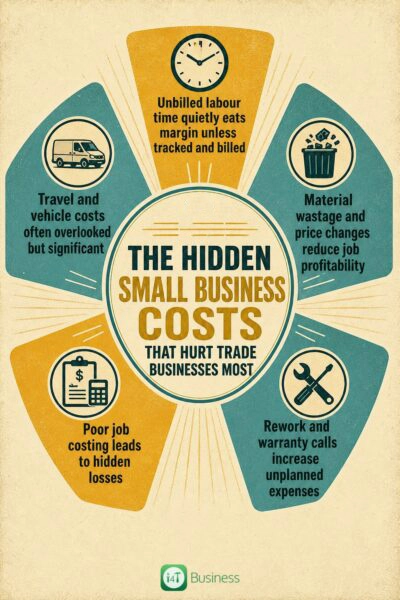
- Unbilled labour time quietly eats margin unless tracked and billed
- Travel and vehicle costs often overlooked but significant
- Material wastage and price changes reduce job profitability
- Poor job costing leads to hidden losses
- Rework and warranty calls increase unplanned expenses
3. How to Calculate the Real Cost of a Trade Job
To understand true profitability, you need to calculate the real cost of a job using this formula:
Real job cost = labour + materials + subcontractors + travel + equipment + admin + overhead allocation + rework allowance.
Then determine your real profit by subtracting this cost from your invoice amount:
Real profit = invoice amount – real job cost.
For example, imagine an electrician’s repair job invoiced at $800. Initial labour and materials cost $450. But once travel time and fuel ($50), admin and paperwork ($30), equipment use and maintenance ($40), overhead allocation ($100), and a small rework allowance ($30) are added, the real cost hits $700. That leaves a real profit of $100 — not $350 as originally assumed. If any of these hidden costs increase unnoticed, the real profit shrinks even more.
4. Signs Your Trade Business Prices Are Too Low
Being busy isn’t always a sign of financial health. Your prices might be too low if you’re booked out but that cash flow feels tight. Winning nearly every quote could mean your rates undervalue your skills and costs.
Other warning signs include not paying yourself consistently, avoiding detailed profitability reports, relying on credit cards to cover slow periods, or feeling constantly pressured to secure the next job just to pay bills. These all point to a hidden problem with pricing and profit margins, often masked by high workload.
5. How to Reduce Small Business Costs Without Cutting Quality
Reducing costs doesn’t mean lowering your workmanship or customer service. Instead, focus on smarter processes to protect quality and improve profits.
Use quoting templates that capture all costs clearly, including travel and admin. Track job costs closely to spot inefficiencies early. Review suppliers regularly to negotiate better deals or switch to more cost-effective options without compromising materials.
Improve scheduling to reduce downtime and travel. Send invoice reminders promptly and enforce deposit requirements to keep cash flow steady. Formalise variation approvals to prevent absorbing extra work for free. Job checklists ensure work is done right first time, cutting costly rework.
Each small improvement in these areas can add up to much better profit without touching quality standards.
6. The 5 Profit Leaks Framework
Understanding where profit leaks occur helps focus your fixes. Here’s a straightforward framework to identify and tackle the main areas:
1. Pricing Leaks: Underpricing jobs, missing hidden costs in quotes, and not charging for variations.
2. Time Leaks: Unbilled labour, travel time not accounted for, admin hours eating into paid work.
3. Material Leaks: Waste, price increases, or ordering inefficiencies eroding margins.
4. Process Leaks: Poor scheduling, rework, callbacks, inefficient workflows increasing costs.
5. Cash Flow Leaks: Late payments, poor invoicing processes, and inadequate deposit management straining finances.
By inspecting these leaks regularly, trade businesses can develop targeted improvements to plug profit holes.
7. A 30-Day Plan to Find and Fix Hidden Costs
Here’s a straightforward 30-day action plan to start plugging profit leaks:
Week 1: Review recent jobs and identify profit leaks. Analyse completed jobs to spot where hidden costs appeared. Look for unbilled labour, travel costs, material waste, and rework.
Week 2: Improve quoting and pricing. Update quote templates to include all costs. Set clear variation pricing and deposit policies.
Week 3: Enhance scheduling, job notes, and rework prevention. Streamline job scheduling to reduce downtime. Use checklists and detailed job notes to avoid mistakes.
Week 4: Tighten payments, deposits, reminders, and variation approvals. Implement deposits on jobs, send timely invoice reminders, and formalise variation approval processes.
Repeat this cycle regularly to keep costs and profit margins in check.
Manage Your Costs with i4T Business Job Management Software
If hidden costs have your trade business feeling busy but not profitable, it’s time to get better control. i4T Business Job Management Software provides a practical way to gain clear visibility over job details, scheduling, quoting, invoicing, admin, and follow-ups—all from one place.
With i4T Business, you can reduce admin time, keep work organised, ensure quotes cover all your costs, and manage payments more efficiently. This helps plug profit leaks before they grow and gives you more confidence in managing your trade business for long-term success.
Frequently Asked Questions
Hidden costs are expenses not clearly tracked or priced into jobs, like travel time, admin, rework, and equipment wear.
Busy doesn’t mean profitable if hidden costs, poor pricing, or unpaid labour reduce your margins on each job.
Track labour, materials, travel, admin, overheads, rework, equipment, insurance, and cash flow timing.
Add up labour, materials, subcontractors, travel, equipment, admin, overheads, and rework to get the real job cost.
Improve quoting, scheduling, supplier reviews, payment processes, and reduce rework without lowering quality.
Yes, charging travel time helps cover fuel, vehicle wear, and unpaid hours, protecting your profit.
Review costs and profits monthly or quarterly to catch leaks early and keep margins healthy.